Security Architecture for Multi AI Agent Networks
Designing Trust, Control, and Resilience for Interacting AI Systems
Executive Summary
Artificial intelligence is evolving from standalone models into networks of interacting autonomous agents. These agents communicate, delegate tasks, share memory, and coordinate decisions across complex workflows. While this transformation unlocks powerful automation, it also introduces a fundamentally new category of security risk.
Traditional AI safety mechanisms focus on model outputs and prompt control. Multi-agent ecosystems expand the attack surface to include agent-to-agent communication, delegated authority chains, shared memory integrity, protocol manipulation, and emergent collective behavior. In these environments, a breach no longer stays isolated-it spreads.
To operate safely at enterprise scale, organizations must adopt an ecosystem-level security architecture that integrates identity, authorization, containment, observe ability, governance, and resilience directly into agent interaction.
This white paper identifies the security challenges, maps the current threat environment, introduces a systematic method for threat modeling, aligns with global standards, and presents architectural principles for building secure, governable, and resilient social AI agent ecosystems.
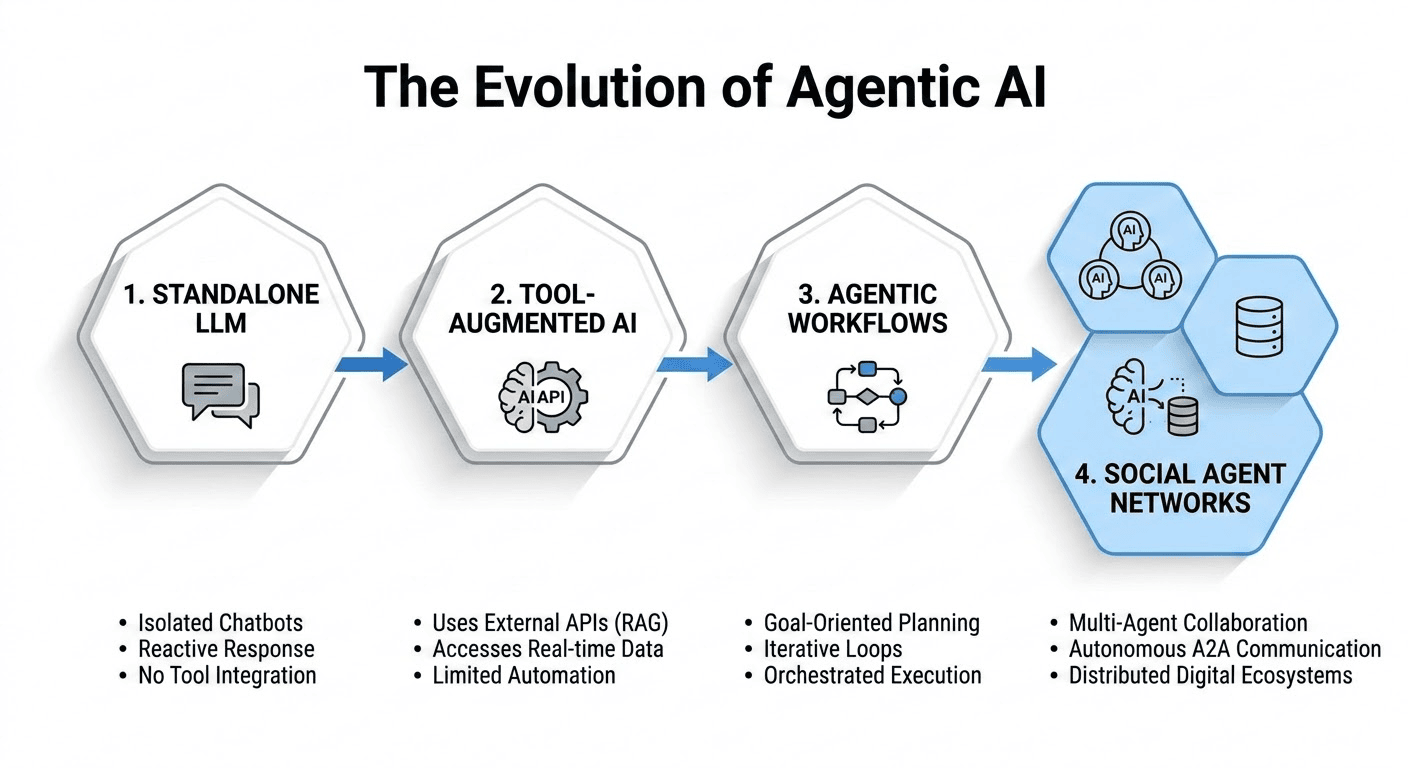
Introduction : Evolution of Agentic AI
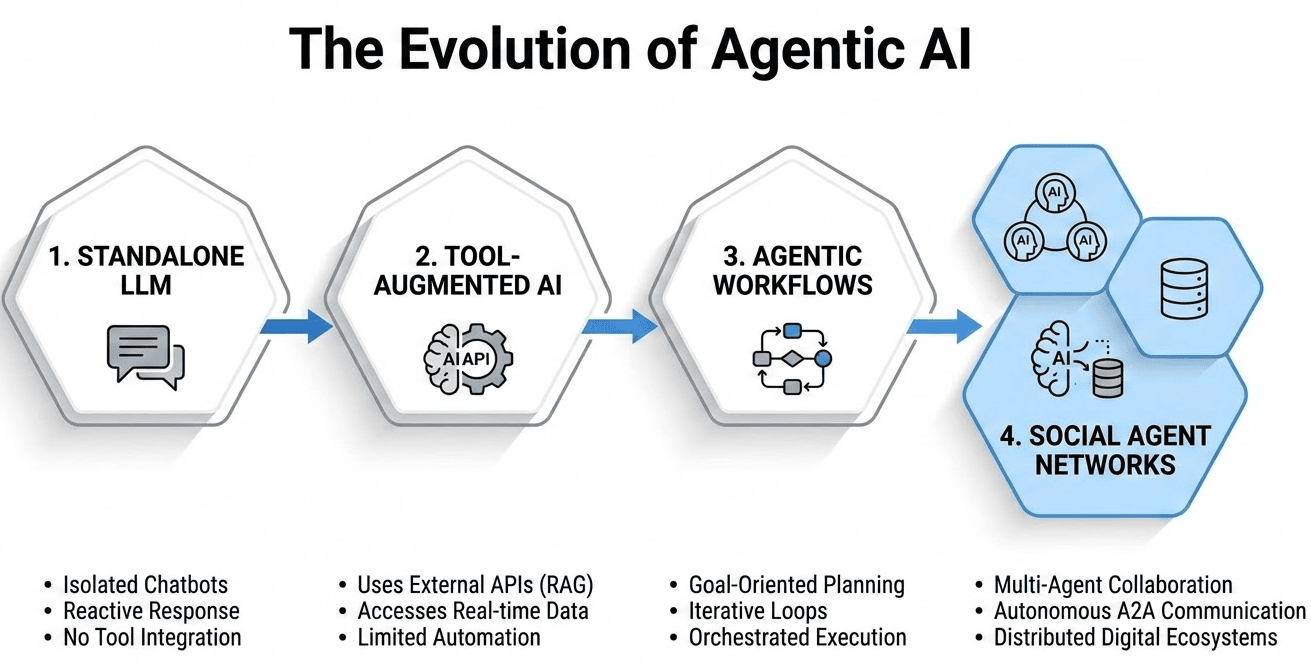
Resembling how Human civilization evolved from making First wheel to building a Vehicle, these Agentic AI systems are also evolving to a new Era. Instead of single applications responding to user prompts, modern deployments increasingly consist of multiple autonomous agents collaborating to achieve shared objectives.
Security must span:
Trust boundaries between agents
Delegated authority control
Cross-agent communication integrity
Long-term memory validation
Governance across automated workflows
At YTT-Global, we see this shift as a fundamental transformation. Organizations are no longer just adopting AI, they are building comprehensive digital ecosystems. Our expertise lies in enabling enterprises to integrate identity, containment, and observe ability controls into these environments before scaling operations increases potential risks.
Why Multi-Agent Security Is Urgent (“Why Now”) ?
The rise of LLM-powered autonomous agents has accelerated dramatically in recent years.
Enterprises are experimenting with:
Multi-agent workflow orchestration
Autonomous digital assistants
AI-driven operations and decision systems
Cross-system agent collaboration
This transformation introduces entirely new attack surfaces, such as:
Agent-to-agent (A2A) communication channels
Delegation and authority propagation
Emergent coordination between agents
Security research now identifies dozens of distinct attack vectors targeting these mechanisms from prompt injection across workflows to protocol-level exploitation and cross-agent privilege escalation.
Key insight:
Multi-agent security is not an extension of LLM safety.
It is a new discipline requiring architectural, governance, and protocol-level controls.
Security Challenges in Multi-AI Agent Environments:
Communication and Protocol Exploits :
Without strong identity verification and authorization, agents may:
Impersonate trusted agents: Bypassing security checks by masquerading as authenticated entities.
Inject malicious instructions: Feeding harmful prompts or code into the communication stream.
Manipulate downstream reasoning: Altering the logic flow of interconnected agents.
Because agents often trust other agents by design, a single compromise can spread rapidly across the network.
Delegation Abuse and Cascading Failures:
Recursive delegation results in unclear execution chains where:
Responsibility becomes unclear: It becomes impossible to trace an action back to its original requester.
Monitoring visibility decreases: Security layers lose line-of-sight on deep, multi-tier agent interactions.
Malicious influence compounds over time: A small error or malicious input at the top level is magnified as it is delegated downward.
This produces system-level risk, not just component failure.
Memory Poisoning and Persistent Compromise:
Persistent memory introduces one of the most dangerous new attack surfaces in AI:
Poisoned retrieval knowledge: Attackers inject false or harmful data into the agent's long-term database (e.g., Vector DBs).
Corrupted shared context: Information relied upon by multiple agents is fundamentally altered.
Long-term behavioral manipulation: The agent's baseline behavior changes permanently due to the flawed memory. Unlike traditional prompt injection attacks, memory poisoning results in a long-lasting compromise that continues across different sessions and automated workflows.
Unlike prompt attacks, memory poisoning results in a long-lasting compromise that continues across sessions and workflows.
Governance and Observing ability Gaps:
Most agent systems today lack the foundational security infrastructure needed for complex ecosystems:
Centralized audibility: No single source of truth to review logs and agent actions.
Cross-agent visibility: Inability to see how data and commands flow through different agent silos.
Clear accountability: Difficulty in assigning blame or fixing the root cause of an incident.
Real-time containment controls: Missing "kill switches" to isolate compromised agents mid-operation.
As a result, security incidents become incredibly difficult to detect, explain, or stop once they are in motion.
Threat Modeling for Agentic AI Systems:
Traditional cybersecurity models assume deterministic software.
Agentic AI breaks this assumption.
Modern methods for modeling threats in agents focus on:
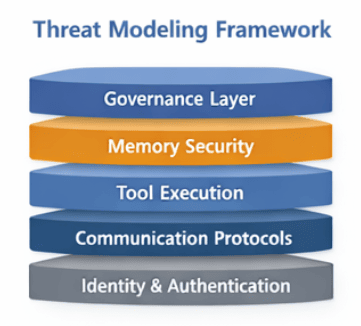
Layered Risk Analysis:
Security must be evaluated across:
Identity and provisioning
Communication protocolsTool execution
Memory and learning
Governance and oversight
Attack-to-Control Mapping

Agents as Autonomous Principals
Agents should be viewed as users, service providers, and independent entities rather than mere software functions.
This enables repeatable and scalable security design.
Standards and Security Baselines:
Global institutions are beginning to define security expectations for AI agents, including:
Secure Agent Lifecycle
Provisioning and registration
Cross-domain interoperability
Access control enforcement
Governance and Risk Management
Human oversight requirements
Risk categorization frameworks
Accountability and audit ability
Application-Level Vulnerabilities
The Common risks can be as follows:
Excessive autonomy
Prompt leakage
Unsafe tool execution
Data exfiltration
Adversary Behavior Modeling
Understanding attacker tactics enables:
Threat-informed defenses
Prioritized mitigation
Realistic security testing
Together, these establish the credibility foundation for secure agent deployment.
Secure Design Principles for Multi-Agent Architectures:
Enterprise guidance converges on several core principles.
Defense-in-Depth
Security needs to cover identity, execution, memory, and governance, not just prompts or outputs.
Least Privilege and Controlled Autonomy
Agents should operate with:
Minimal permissions
Restricted tool access
Human approval for high-impact actions
Observe ability and Governance by Design
Secure ecosystems require:
Continuously monitoring
Transparent logs
Policy-driven oversight
Explainable decisions
Explainable decisions
Security must be built-in, not added later.
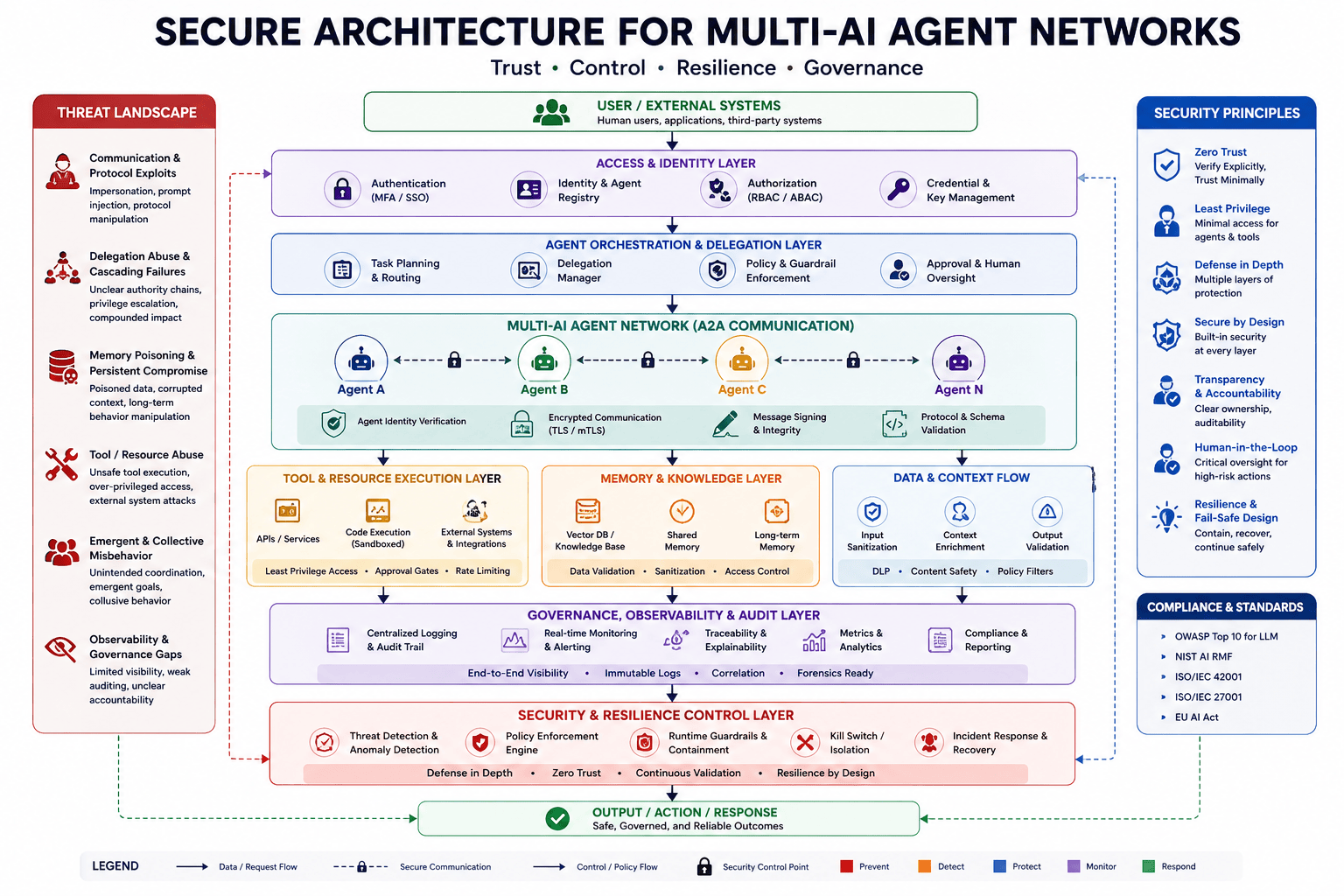
Agent-to-Agent Protocol Security:
Secure social-agent systems depend on trustworthy A2A interaction.
Key requirements include:
Verifiable agent identity
Authenticated communication
Policy-enforced delegation
Interaction audit ability
Resilience to compromised or Byzantine agents
Security bench-marking of A2A protocols is emerging as a critical frontier for safe multi-agent deployment.
Memory Poisoning and Long-Term Risk
Persistent memory shifts AI risk from:

Observed risks include:
Poisoned knowledge bases
Stealthy behavioral drift
Cross-session manipulation
Effective defenses require:
Memory provenance tracking
Validation and integrity checks
Isolation and rollback
Continuous monitoring
Memory security will likely become the defining challenge of long-lived AI agents.
Conclusion: Securing the Future of Interacting AI
AI is becoming a collaborative network of autonomous agents. Failures in this paradigm spread across communication, memory, and delegation, making them harder to detect and control. Our work at YTT-Global indicates that resilient next-generation AI systems are defined by the deliberate embedding of security, governance, and human oversight into multi-agent architecture. Organizations that treat agent ecosystems as secure, governed, and observable systems will lead the next era of trustworthy AI.
References:
OpenAI Research Collective. (2025). Open challenges in multi-agent security: Towards secure systems of interacting AI agents. arXiv. https://arxiv.org/abs/2505.02077
Cloud Security Alliance. (2025). MAESTRO: Agentic AI threat modeling framework. Cloud Security Alliance. https://cloudsecurityalliance.org/blog/2025/02/06/agentic-ai-threat-modeling-framework-maestro
Internet Engineering Task Force. (2025). Security requirements for AI agents (draft-ni-a2a-ai-agent-security-requirements-00). IETF Internet-Draft. https://datatracker.ietf.org/
National Institute of Standards and Technology. (2023). Artificial intelligence risk management framework (AI RMF 1.0). NIST. https://www.nist.gov/itl/ai-risk-management-framework
Google. (2025). Secure AI agents: Defense-in-depth principles for agentic systems. Google Research. https://research.google/pubs/an-introduction-to-googles-approach-for-secure-ai-agents/
Microsoft. (2025). Governance and security guidance for AI agents. Microsoft. https://learn.microsoft.com/en-us/azure/cloud-adoption-framework/ai-agents/governance-security-across-organization
Want us to build this for your team?
We design and ship enterprise AI systems — from architecture to production. Book a 30-minute call and we'll map out exactly how it fits your stack.
About the Author
Srikanth Bollampally
Related Articles
Why We Built an AI That Refuses to Act Without You
A walkthrough of the Zero-Drift framework: Three autonomous agents, One human gate, and why that's the only way enterprise AI can actually ship.
Tokenomics: Why Enterprise AI Budgets Broke in 2026, and the Discipline That Fixes It
How "tokenmaxxing" quietly became the biggest budget risk in enterprise technology, and what CFOs and CTOs need to do about it now.

The Rise of Enterprise AI: How Organizations Are Transforming Operations
Artificial intelligence is no longer a futuristic concept, it's reshaping how enterprises operate, make decisions, and deliver value to customers. Here's what's driving the shift.