Beyond the PoC: Scaling Generative AI from Lab to Global Production
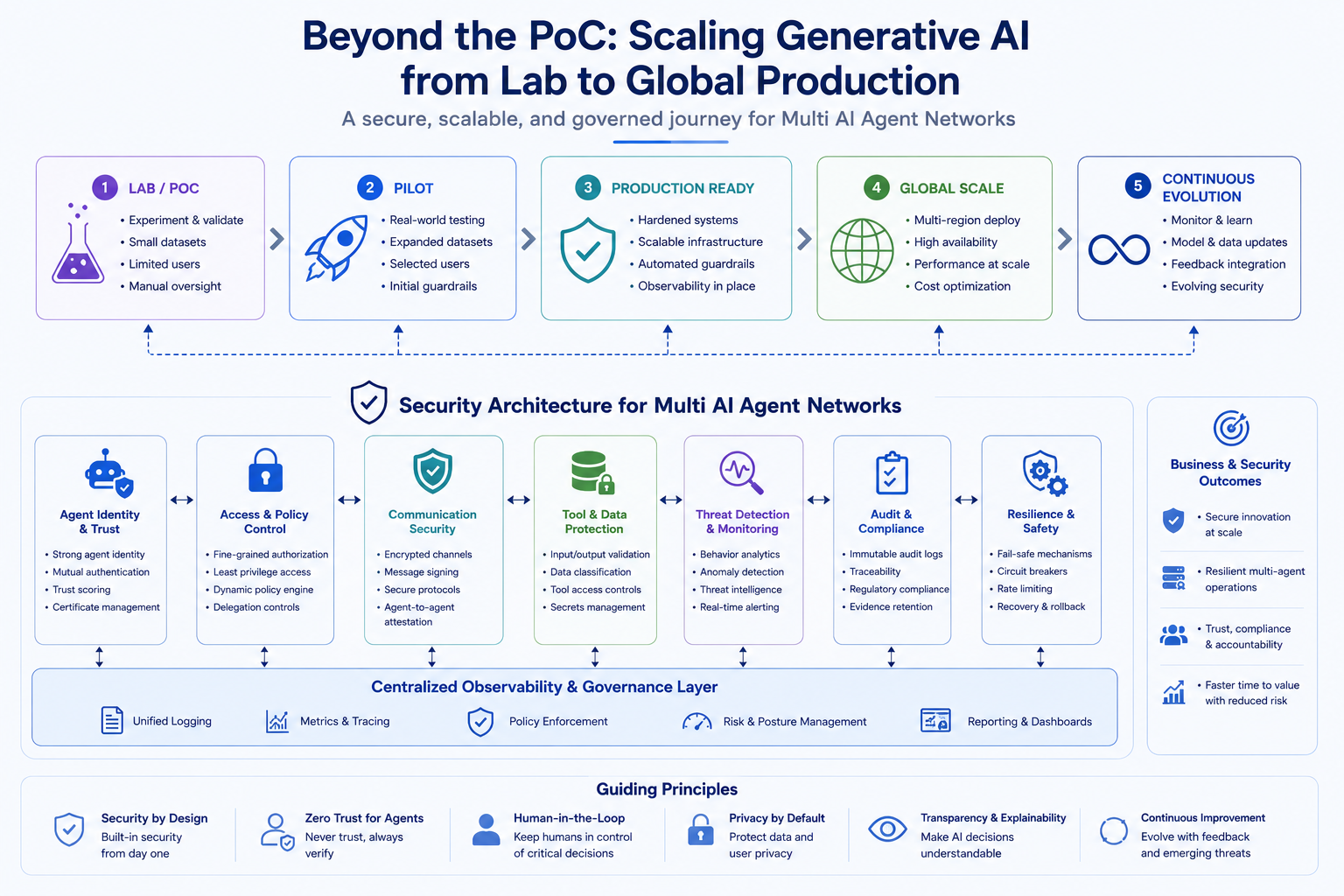
The AI Execution Gap: From Sandbox to Scale
Eighty percent of enterprise AI projects never leave the Proof of Concept stage. That figure, cited consistently across research from Gartner, McKinsey, and IBM, points to a structural failure in how organizations approach AI deployment — not a failure of the technology itself. The bottleneck is not ambition. It is execution. The gap between a working sandbox model and a production system serving millions of users across multiple jurisdictions is where most enterprise AI programs die. Bridging it requires a different discipline than building the demo: one defined by infrastructure architecture, regulatory fluency, and operational rigor that very few implementation partners actually possess. Controlled pilots mask the complexity of real-world deployment. When an AI system moves from a single-user test environment to global production, three challenges emerge simultaneously — each capable of derailing the program on its own. In production, latency is a revenue variable. Research by Akamai and Google consistently shows that a 100-millisecond delay in response time reduces conversion rates by up to seven percent. Centralized inference architectures compound this problem for international deployments: when users in Singapore, Dubai, or São Paulo are routed to a single inference endpoint, latency spikes are not edge cases — they are the norm. Simultaneously, token consumption costs scale non-linearly with usage volume, and architectures that are economical at PoC scale can become financially unsustainable within months of launch. Global AI deployments operate across a fragmented regulatory environment with no unified standard. GDPR in the European Union, CCPA in California, the Digital Personal Data Protection Act in India, and local data residency mandates in Singapore and the UAE impose different and sometimes conflicting requirements on how data is collected, processed, stored, and transferred. A compliance strategy built for one jurisdiction rarely transfers cleanly to another. Organizations that treat data governance as an afterthought in their AI architecture consistently discover this at the worst possible moment: post-launch, under regulatory scrutiny. Enterprise AI systems cannot operate as black boxes. Without production-grade observability, organizations have no reliable mechanism for detecting model drift, identifying hallucinations before they reach end users, or producing the audit trails that regulators and enterprise procurement teams increasingly require. IBM's AI in Action 2023 report found that lack of explainability and transparency is among the top three barriers to AI adoption at scale — cited by more than 40 percent of senior executives surveyed. An AI system without observability infrastructure is not a strategic asset; it is a corporate liability. Closing the AI Execution Gap requires a structured implementation approach that addresses infrastructure, compliance, and reliability in parallel — not sequentially. The following framework reflects what production-grade AI deployment actually demands. Moving inference closer to the user is the most direct lever for solving the latency-cost paradox. Globally distributed serverless compute environments — including Cloudflare Workers and equivalent regional infrastructure — allow inference to execute at the network edge, dramatically reducing round-trip time for international users. Layered on top of this, intelligent semantic caching identifies and serves repeated or structurally similar queries from cache rather than triggering new LLM inference calls. Organizations that have implemented this architecture consistently report latency reductions of 40 to 60 percent and proportional reductions in operational token costs at scale. Production AI requires a security and compliance middleware layer that operates between the user and the model. Effective guardrails perform three functions: PII redaction, which identifies and masks sensitive personal data before it reaches the model; prompt injection defense, which neutralizes adversarial inputs designed to bypass model safety constraints; and topic hardening, which enforces domain boundaries to ensure the AI operates strictly within its designated business function. These guardrails are not optional enhancements — they are foundational to operating AI in regulated industries and enterprise environments where compliance failures carry material consequences. A general-purpose language model has no access to an organization's proprietary data, internal documentation, or operational knowledge. Retrieval-Augmented Generation (RAG) solves this by grounding model outputs in a continuously updated corpus of enterprise-specific information. At scale, this requires distributed vector database infrastructure capable of handling high query volumes with low latency — not the single-node vector stores that typically power PoC demonstrations. When implemented correctly, RAG systems allow organizations to deploy AI that speaks authoritatively about their products, processes, and policies, while maintaining the data sovereignty controls that enterprise governance requires. A multinational logistics operator processing cross-border shipments across three continental regions faced a structural operational constraint: manual customs documentation entry was introducing a consistent 48-hour delay between shipment clearance approval and actual border processing. The delay was not caused by regulatory complexity — the compliance framework was well understood. It was caused by the volume and inconsistency of documentation formats arriving from multiple origin countries, which made automation with traditional rules-based systems impractical. The implemented solution deployed a RAG-based AI system integrated directly into the client's legacy ERP, with inference nodes distributed across three regional cloud environments to satisfy local data residency requirements. The system was trained on jurisdiction-specific customs documentation formats and regulatory schemas, enabling it to parse, validate, and complete documentation packages with minimal human intervention. Post-deployment, documentation processing time dropped from 48 hours to 12 minutes. The 99.8 percent accuracy rate was independently verified by customs authorities in the relevant jurisdictions. The operational cost reduction in the first year offset the full implementation investment. The era of AI experimentation is closing. The organizations that will define the competitive landscape of the next decade are not those with the most sophisticated models or the most ambitious AI strategies — they are those that have solved the harder problem of taking AI from a local proof of concept into a global production system that performs reliably, complies with the regulatory environments it operates in, and generates returns that compound over time. The technology is no longer the constraint. Execution is. And execution requires a partner who has built production systems before, not one who is learning on your timeline and your budget.The AI Execution Gap
Three Challenges That a PoC Never Encounters
Latency and the Cost Paradox
Multi-Region Data Governance
Observability and Hallucination Risk
The Framework for Taking AI from Strategy to Production
Edge-First Inference Architecture
Autonomous AI Guardrails
RAG and Semantic Retrieval at Scale
Case Study: Logistics Documentation at Global Scale
Conclusion
Want us to build this for your team?
We design and ship enterprise AI systems — from architecture to production. Book a 30-minute call and we'll map out exactly how it fits your stack.
About the Author
Srikanth Bollampally
Related Articles
Why We Built an AI That Refuses to Act Without You
A walkthrough of the Zero-Drift framework: Three autonomous agents, One human gate, and why that's the only way enterprise AI can actually ship.
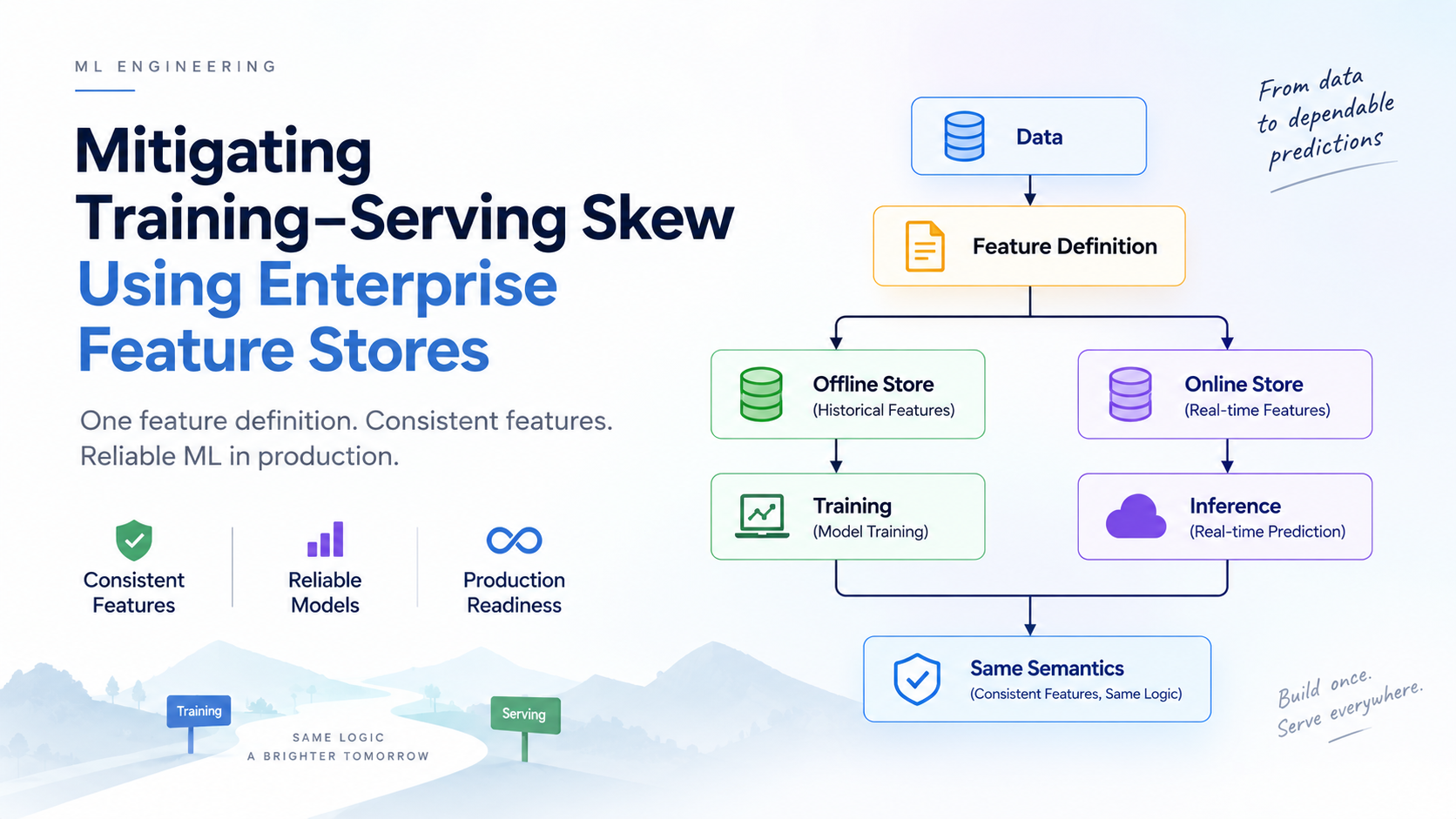
Mitigating Training–Serving Skew Using Enterprise Feature Stores
Building a Single Source of Truth for Production ML Features
Exploring Vidya AI
A Unified School Management Platform Built for Every Stakeholder