Zero Trust Architecture for Agentic AI Systems
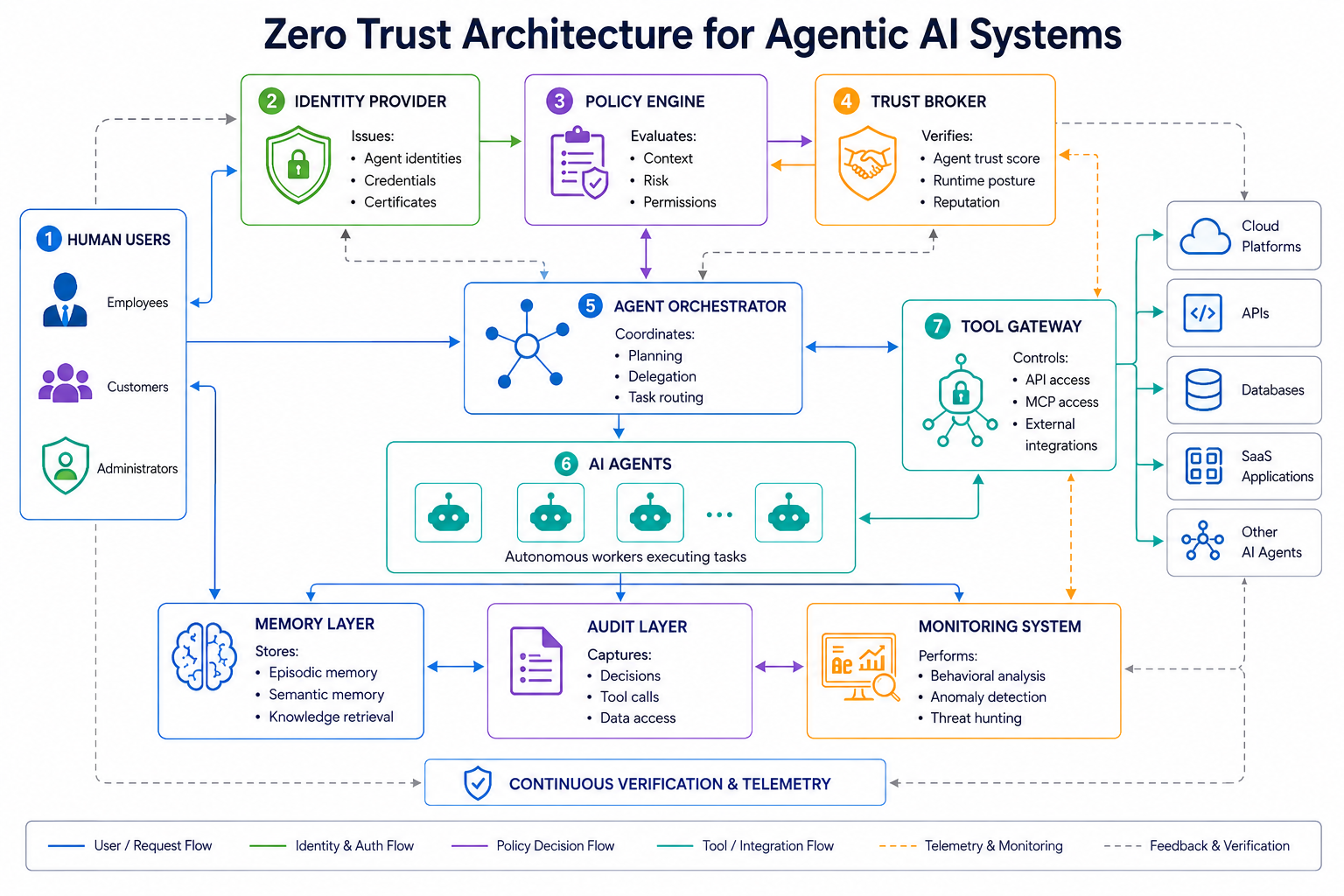
Applying Zero Trust Principles When AI Agents Act
Executive Summary
Agentic AI systems represent the next major evolution of enterprise computing. Unlike traditional AI assistants that merely generate responses, agentic systems perceive, reason, plan, invoke tools, interact with applications, communicate with other agents, and autonomously execute business workflows.
This shift fundamentally changes enterprise security.
Traditional Zero Trust Architecture (ZTA), defined by the National Institute of Standards and Technology (NIST), assumes users, devices, applications, and workloads require continuous verification.
The central challenge is:
How do organizations trust AI agents enough to act while never trusting them enough to act unchecked?
The answer is an AI-native Zero Trust Architecture built around:
Explicit verification
Machine identity
Dynamic authorization
Tool governance
Memory protection
Continuous monitoring
Human oversight
Runtime policy enforcement
Modern security leaders increasingly view agents as workplace individuals rather than software features. Microsoft's emerging "Agent ID" model and Zero Trust for AI guidance exemplify this transition toward treating agents as first-class security principals. (Microsoft)
What Is Zero Trust Architecture?
According to NIST SP 800-207:
No entity should be implicitly trusted based on network location, ownership, or prior verification. Every access request must be continuously authenticated, authorized, and validated. (NIST)
Core principles:
Verify Explicitly
Use Least Privilege
Assume Breach
What Is Agentic AI?
Agentic AI systems are AI systems capable of:
Goal decomposition
Planning
Tool invocation
Workflow orchestration
Autonomous decision-making
Multi-agent collaboration
Long-term memory utilization
Examples:
AI operations agents
Autonomous software engineering agents
AI procurement agents
Security investigation agents
Multi-agent enterprise assistants
OWASP identifies the "agentic skill layer" as a critical new attack surface because it governs autonomous workflows rather than simple prompt-response interactions. (OWASP Foundation)
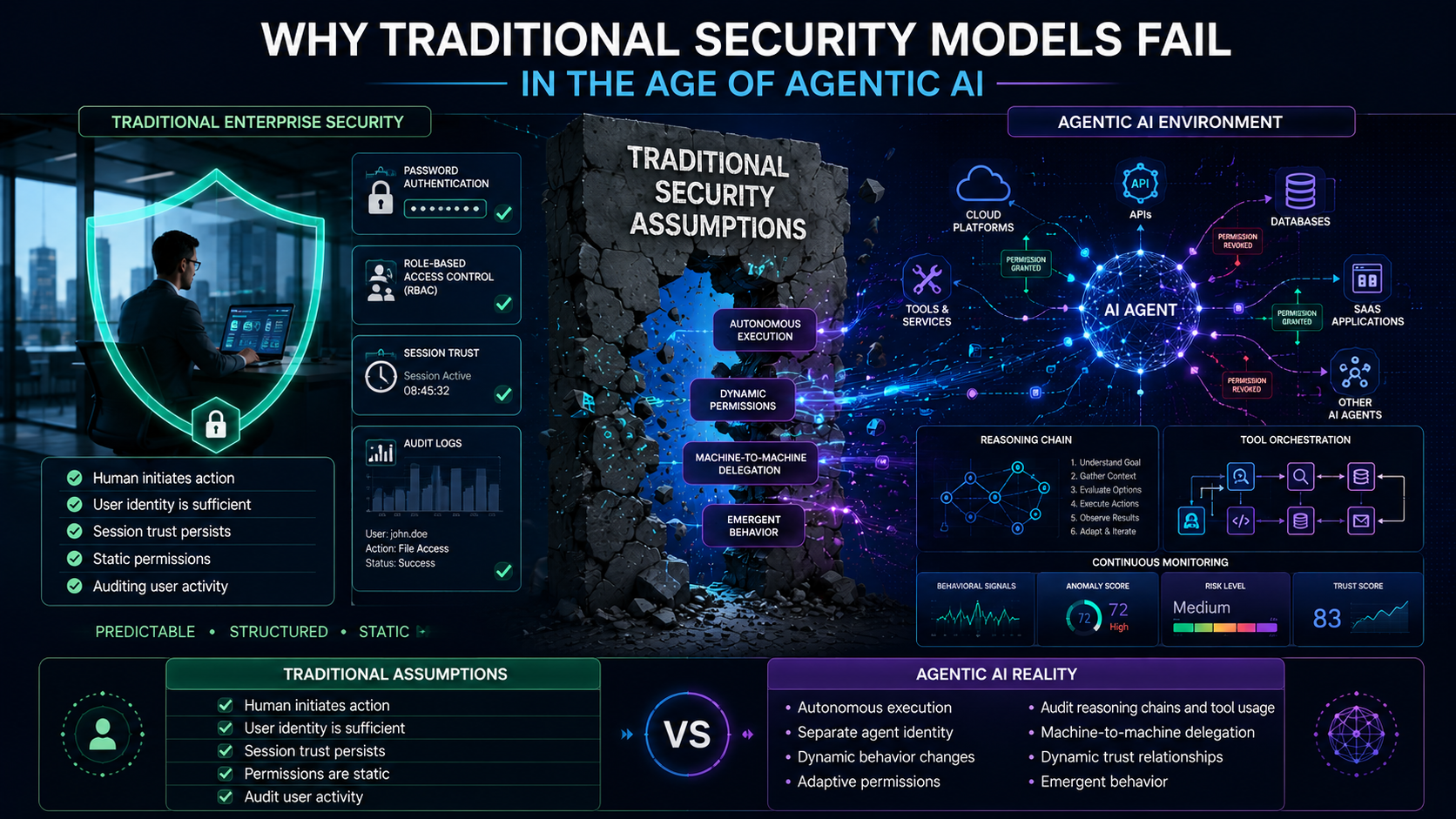
Why Traditional Security Models Fail?
Traditional enterprise security assumes:
Assumption | Why It Fails |
Human initiates action | Agent acts autonomously |
User identity is sufficient | Agent has separate behavior |
Session trust persists | Agent behavior changes dynamically |
Permissions static | Agent needs adaptive permissions |
Auditing user activity | Must audit reasoning chains and tool usage |
Agentic AI introduces:
Non-human actors
Autonomous execution
Dynamic trust relationships
Emergent behavior
Machine-to-machine delegation
Zero Trust Principles Applied to Agentic AI
Traditional ZTA | Agentic AI Equivalent |
User Identity | Agent Identity |
MFA | Cryptographic Agent Authentication |
Device Trust | Runtime Agent Verification |
RBAC | Context-Aware Agent Authorization |
PAM | Tool-Level Privilege Control |
Network Segmentation | Agent Capability Segmentation |
Endpoint Monitoring | Agent Behavior Monitoring |
SIEM | Agent Telemetry Analytics |
Session Validation | Continuous Agent Verification |
Insider Threat Detection | Rogue Agent Detection |
Zero Trust Architecture (ZTA) principles can be adapted for Agentic AI systems, where autonomous agents perform tasks, make decisions, and interact with tools without constant human supervision. While conventional ZTA focuses on securing human users, devices, and network resources, Agentic AI requires extending these controls to intelligent agents and their actions.
Each traditional security control has a corresponding agent-centric counterpart. For example, User Identity becomes Agent Identity, ensuring that every AI agent has a unique and verifiable identity. Multi-Factor Authentication (MFA) evolves into Cryptographic Agent Authentication, allowing secure verification of autonomous agents. Similarly, Role-Based Access Control (RBAC) is transformed into Context-Aware Agent Authorization, where permissions depend on the agent’s task, environment, and risk level rather than static roles alone.
Core Zero Trust Principles for Agentic AI
Verify Explicitly
Every agent action requires verification of:
Agent identity
User identity
Requested capability
Context
Risk level
Destination system
Least Privilege
Agents receive:
Minimal tool access
Minimal data access
Time-limited permissions
Task-specific authorization
Example:
A calendar scheduling agent should never have ERP write access.
Assume Breach
Design as though:
Agent compromised
Prompt injected
Tool poisoned
Memory corrupted
Credentials stolen
NIST's AI Risk Management Framework similarly recommends treating AI systems as continuously evolving risk environments requiring ongoing governance and monitoring. (NIST)
Reference Architecture
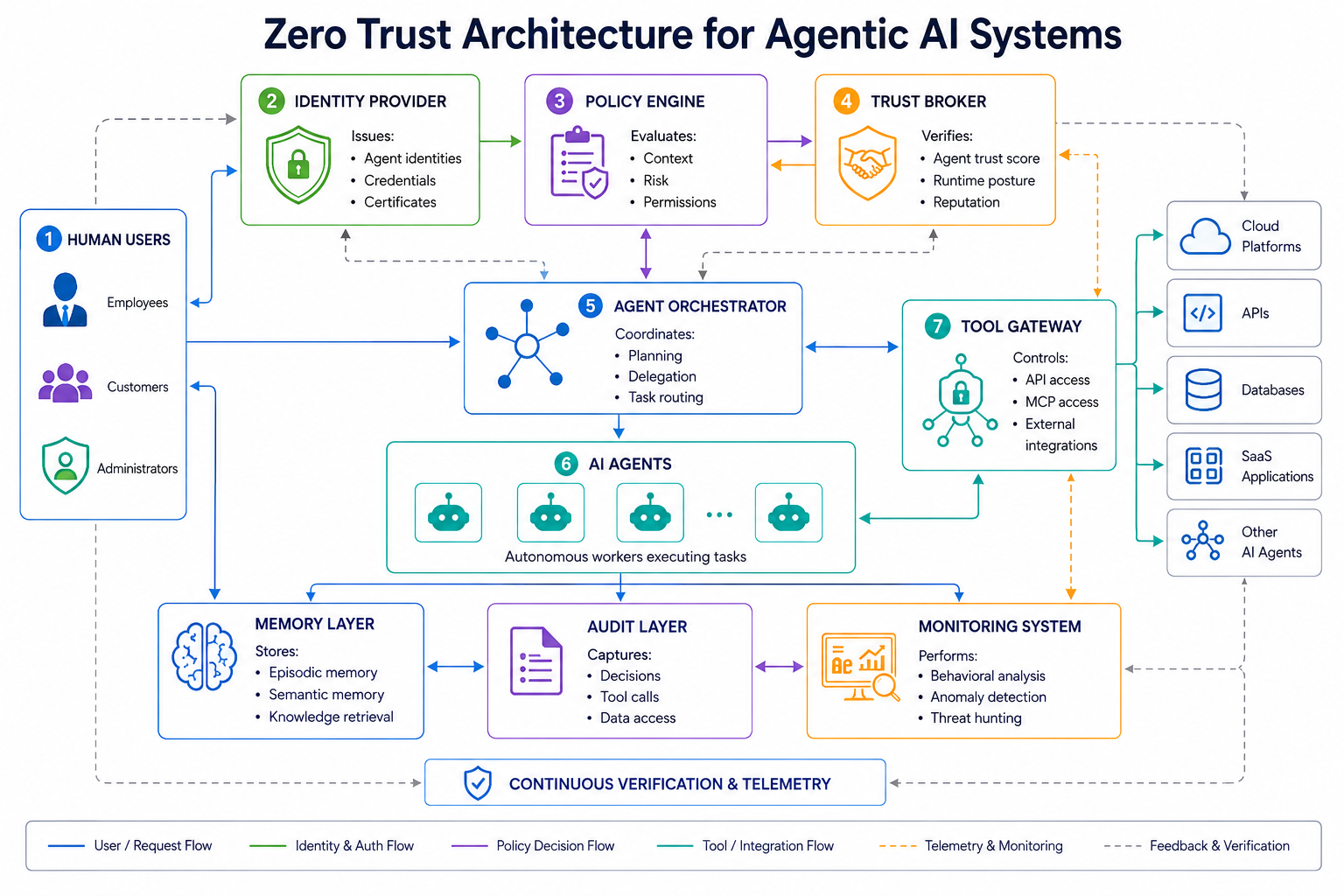
Agent Identity Architecture
Agent Identity Requirements
Every agent must possess:
Unique identity
Cryptographic credentials
Lifecycle management
Revocation capability
Microsoft's Entra Agent ID reflects this emerging pattern by assigning managed identities to AI agents similarly to workforce identities. (Microsoft)
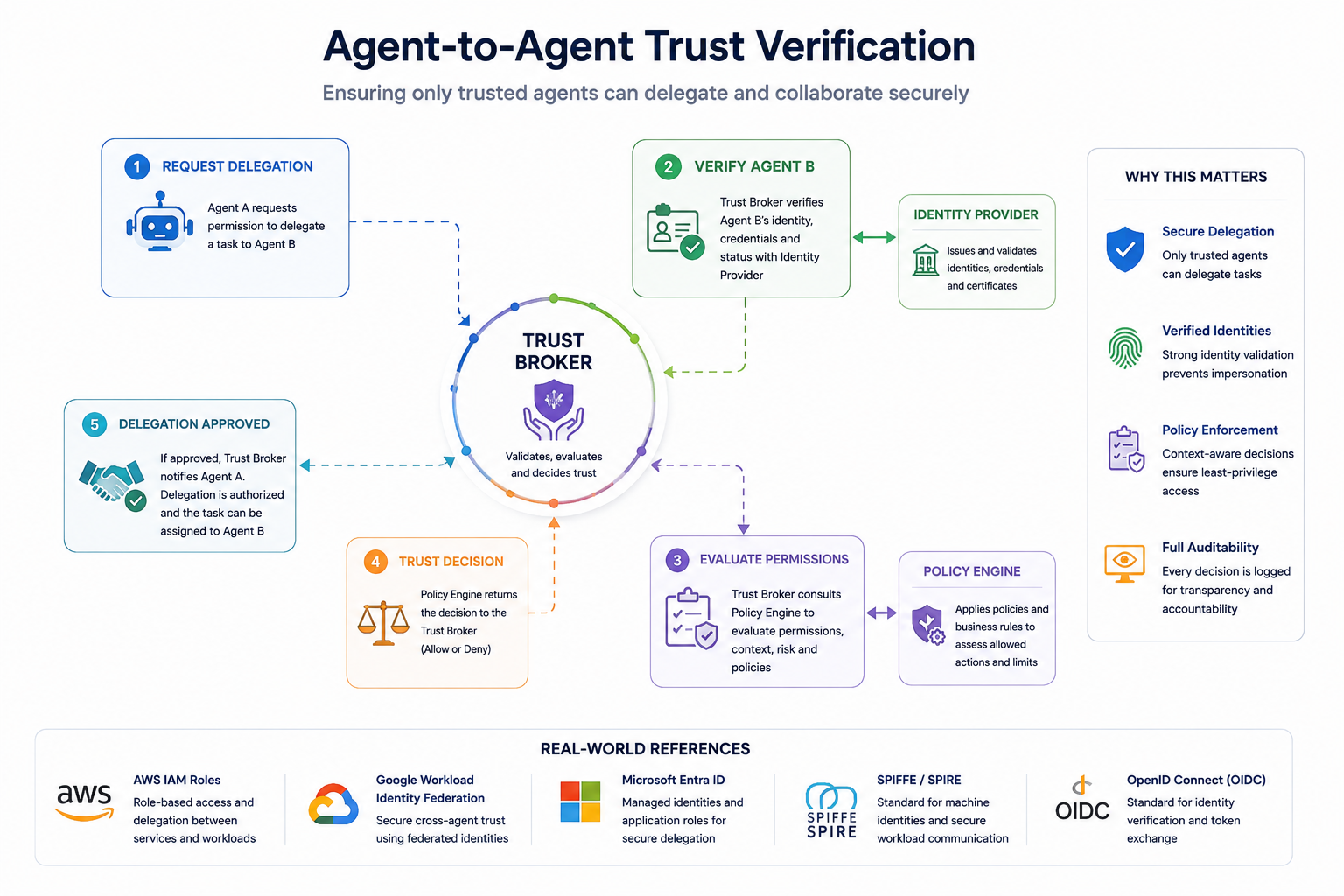
Authorization Architecture
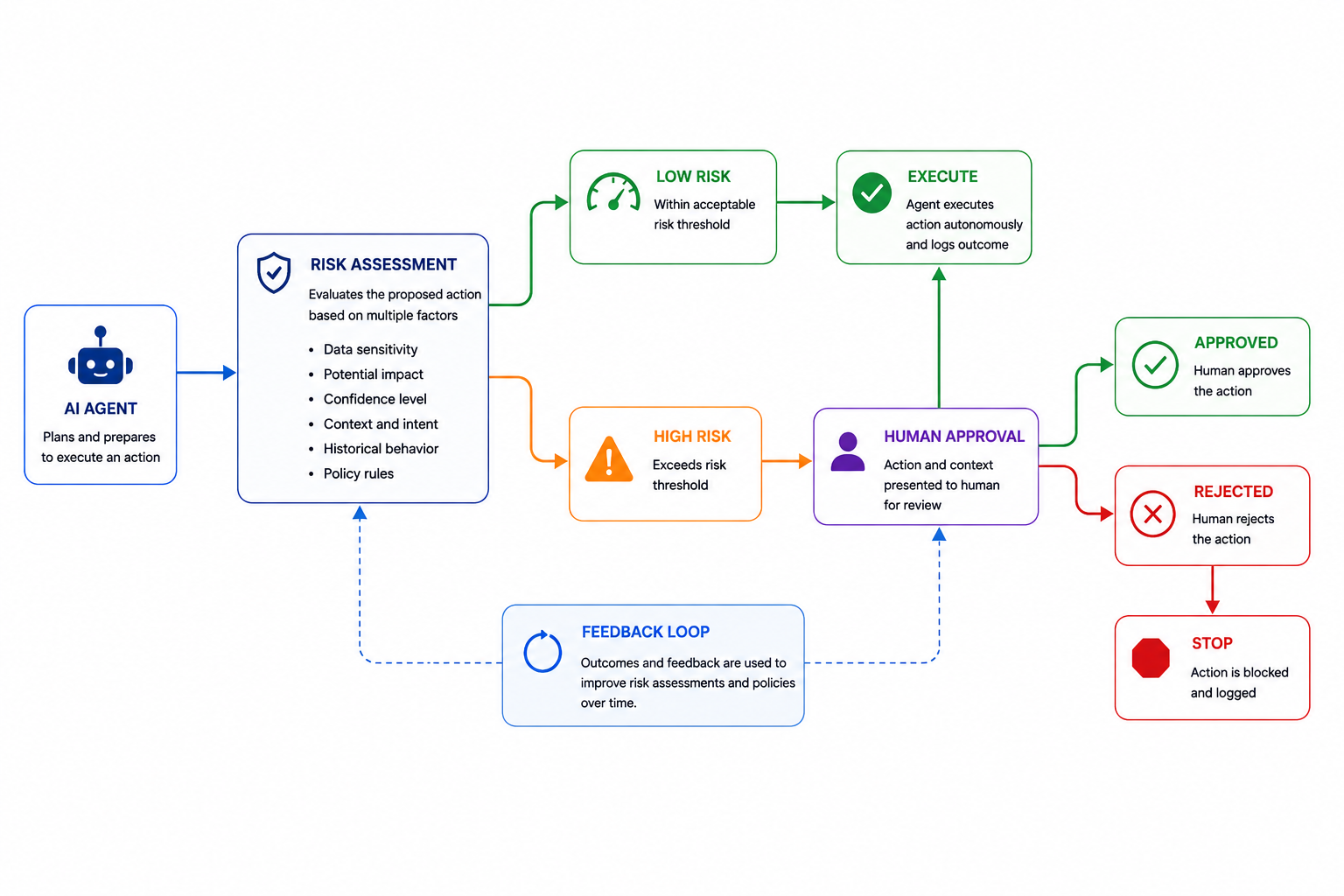
Dynamic Authorization
There will always be a Human in the Loop.
Access decisions should consider:
Current task
User intent
Risk score
Data sensitivity
Tool classification
Authorization Formula
Access = Identity + Context + Risk + Policy
Tool Security
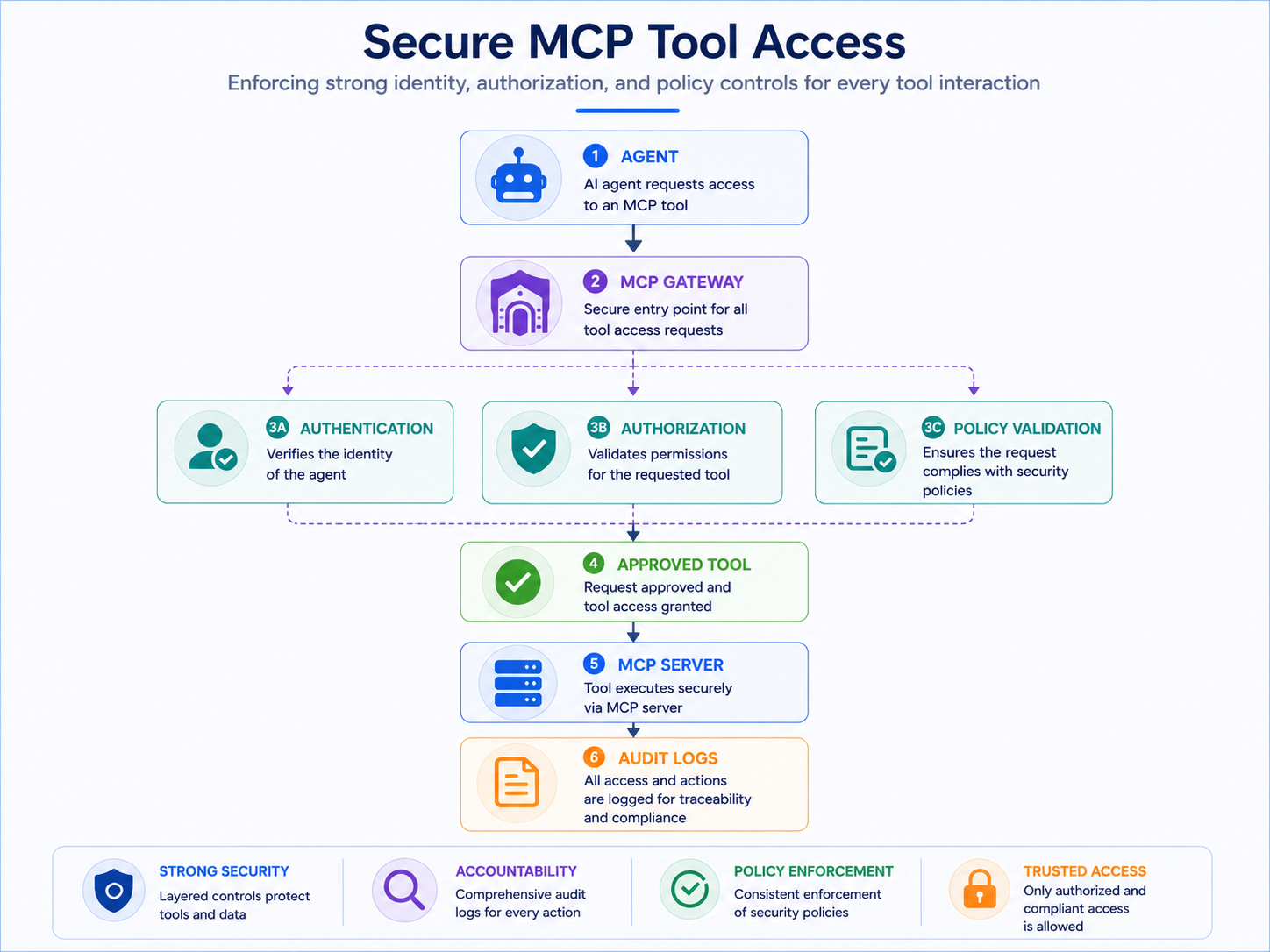
MCP Security Challenges
OWASP MCP Top 10 identifies:
Tool Poisoning
Intent Flow Subversion
Command Injection
Weak Authentication
Shadow MCP Servers
Lack of Telemetry (OWASP Foundation)
Secure MCP Controls
Tool Allow Lists
Tool Signing
Output Validation
Sandboxing
Runtime Scanning
Immutable Logging
Multi-Agent Security
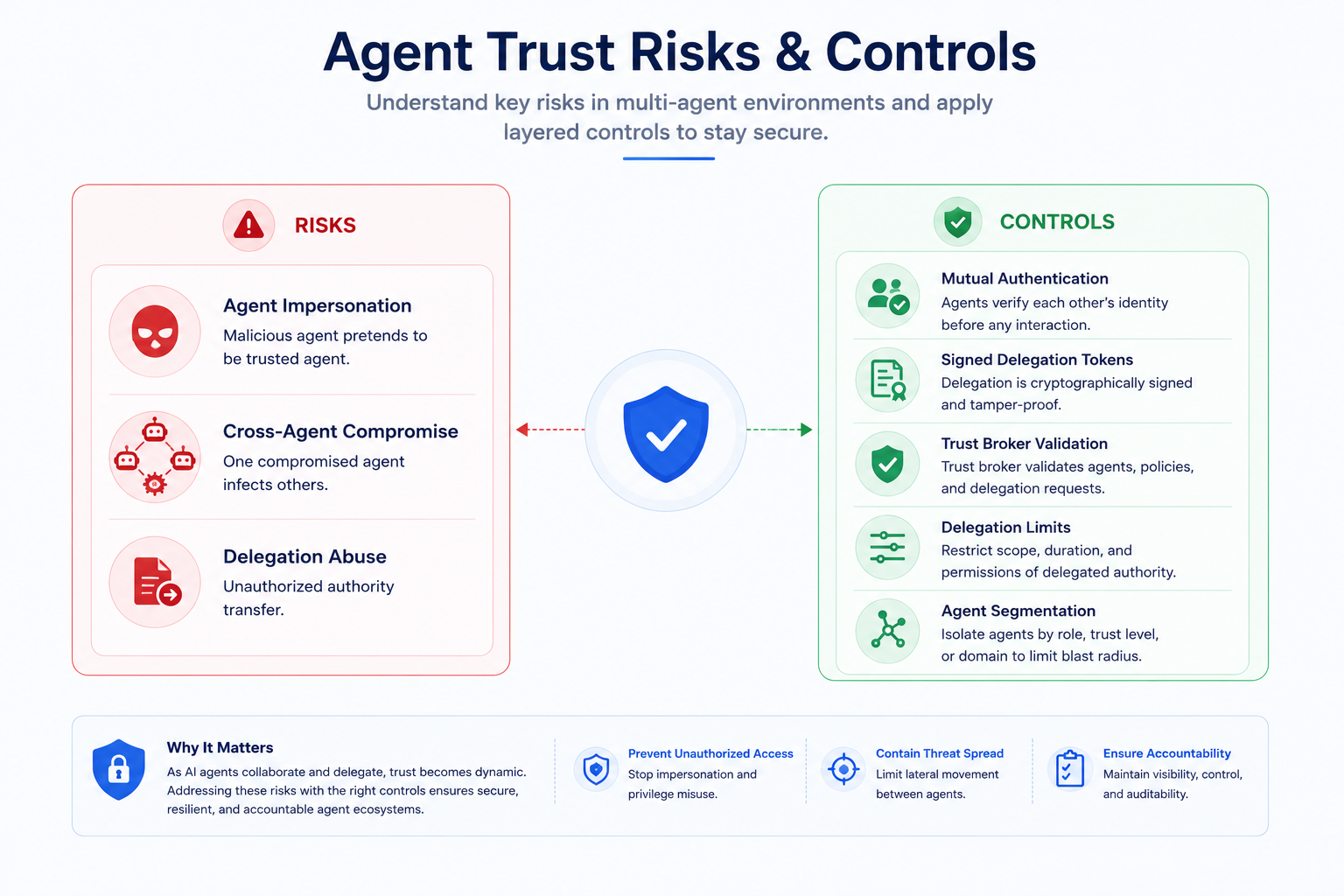
As organizations adopt multi-agent AI systems, agents increasingly collaborate, share context, delegate tasks, and access enterprise resources autonomously. While this enables greater scalability and automation, it also introduces new security risks that traditional application security models were not designed to address.
These controls create a secure trust framework that enables autonomous agents to collaborate safely while maintaining accountability, visibility, and policy compliance. In a Zero Trust Agentic AI architecture, trust is never assumed-it is continuously verified at every interaction, delegation, and decision point.
Runtime Governance
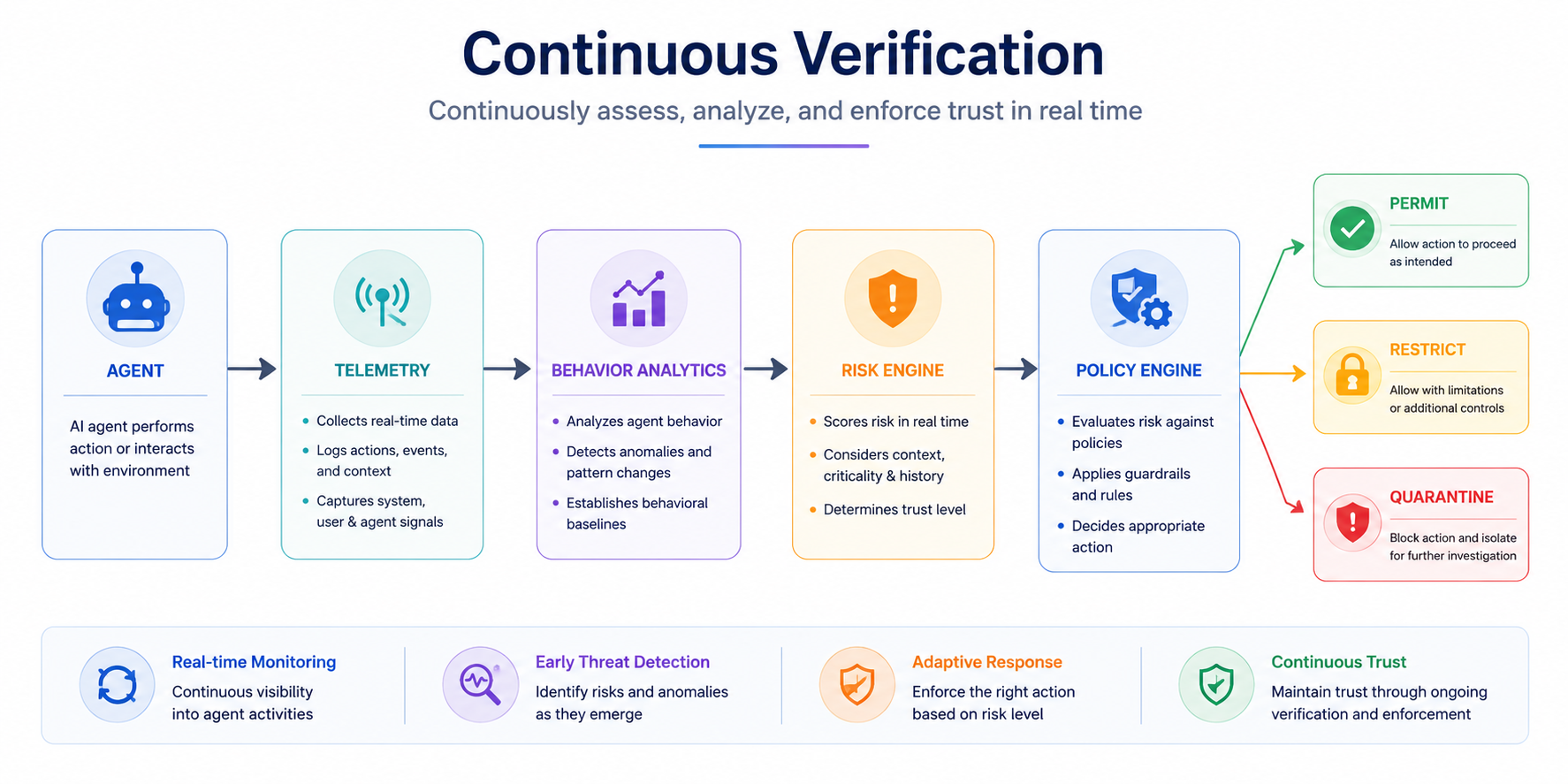
Continuous Verification Model
Instead of: Authenticate Once
Use: Verify Continuously
Monitor:
Tool usage
Resource consumption
Decision patterns
Communication patterns
Data access
Behavioral Analytics Signals
Excessive tool calls
Unusual API usage
Abnormal memory access
New communication paths
Permission escalation attempts
Threat Analysis Matrix
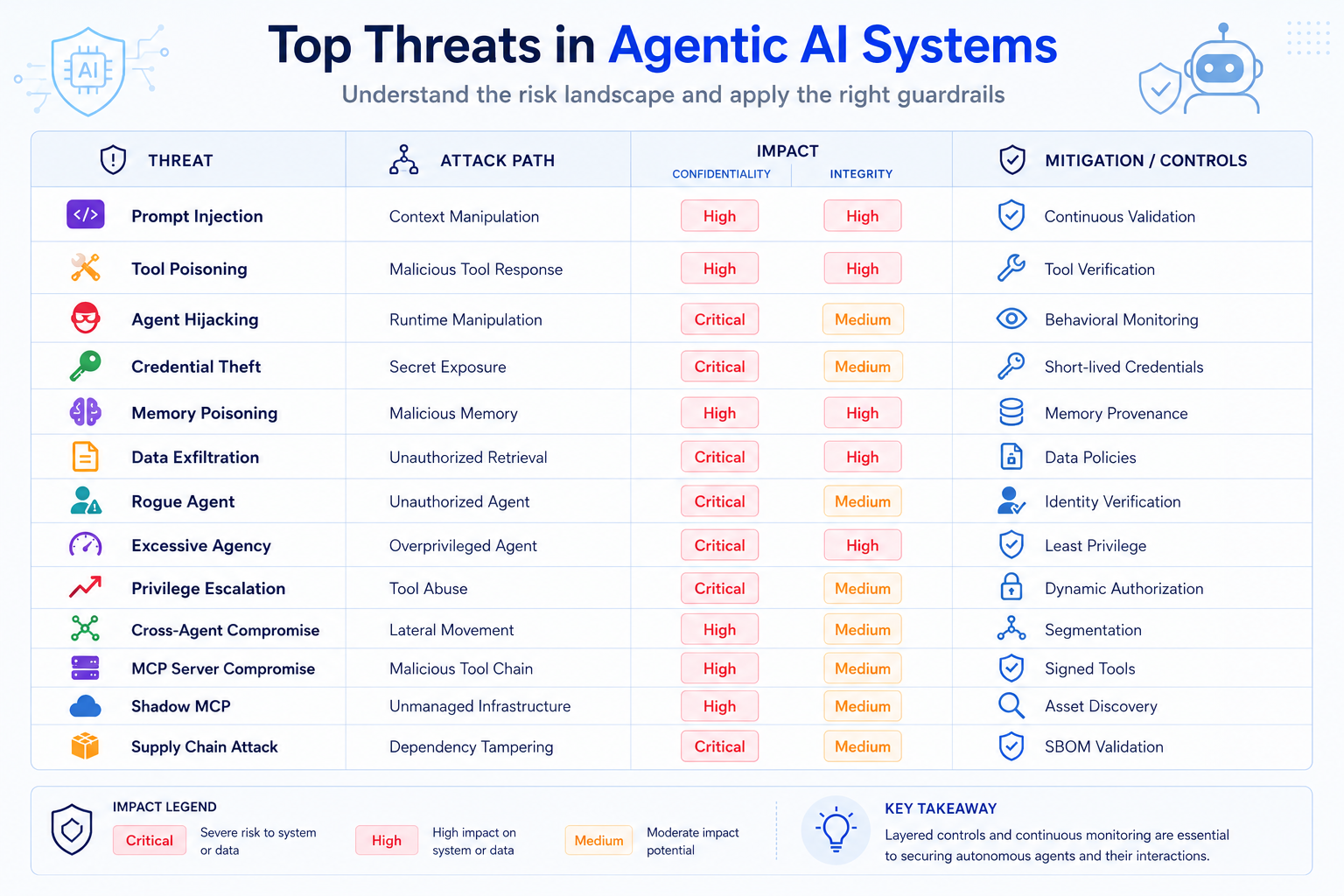
Sources: OWASP Agentic Security Initiative, MCP Top 10, MITRE ATLAS threat categories, and recent MCP security research. (OWASP Gen AI Security Project)
Enterprise Adoption Roadmap
Phase | Focus | Timeline | Maturity |
Phase 1 | Identity Foundation | 0–3 Months | Initial |
Phase 2 | Policy Enforcement | 3–6 Months | Managed |
Phase 3 | Tool Governance | 6–9 Months | Defined |
Phase 4 | Memory Protection | 9–12 Months | Advanced |
Phase 5 | Continuous Verification | 12–15 Months | Optimized |
Phase 6 | Autonomous Security Operations | 15–24 Months | Adaptive |
Security Framework Mapping
Framework | Agentic AI Relevance |
NIST SP 800-207 | Zero Trust Foundation |
NIST AI RMF | AI Governance |
OWASP LLM Top 10 | LLM Threats |
OWASP Agentic Security | Agent Threats |
OWASP MCP Top 10 | Tool Layer Security |
MITRE ATLAS | Adversarial TTPs |
CSA AI Controls Matrix | Cloud AI Controls |
ISO 42001 | AI Management Systems |
Enterprise Best Practices
Governance Controls
Agent registry
Agent inventory
Approval workflows
Risk classification
Security Controls
Cryptographic identities
Tool allowlists
Runtime authorization
Memory encryption
Operational Controls
Change management
Incident response
Red teaming
Agent lifecycle management
Monitoring Controls
Agent telemetry
Decision logging
Tool invocation monitoring
Anomaly detection
Comparative Analysis
Capability | Traditional Apps | AI Assistants | Agentic AI |
Identity | User | User + Model | User + Agent |
Authorization | Static | Semi-Dynamic | Dynamic |
Decision Making | Human | Assisted | Autonomous |
Monitoring | Application Logs | Prompt Logs | Behavioral Analytics |
Governance | IT Governance | AI Governance | AI + Autonomy Governance |
Risk Level | Medium | High | Critical |
Future Outlook
The next generation of Zero Trust will evolve into AI-Native Zero Trust:
Emerging Trends
Cryptographic Agent Identity
Agent Trust Fabrics
Agent Reputation Systems
Autonomous Security Agents
Verifiable Agent Execution
Decentralized Trust Brokers
Policy-as-Code for Agents
Swarm Governance
AI Security Mesh Architectures
Self-Governing Agent Ecosystems
Industry research increasingly points toward "agentic workforces" and autonomous enterprise operations where agents become first-class actors requiring identity, governance, and continuous verification frameworks equivalent to human employees. (Microsoft)
Key Conclusion: In the agentic era, Zero Trust is no longer about users and devices alone. It must extend to autonomous agents, their identities, memories, tools, decisions, and interactions. The organizations that succeed will build security architectures where every agent action is continuously verified, governed, monitored, and accountable.
References
Rose, S., Borchert, O., Mitchell, S., & Connelly, S. (2020). Zero Trust Architecture (NIST SP 800-207). NIST. NIST SP 800-207
NIST. (2023, updated 2024). AI Risk Management Framework (AI RMF 1.0 and GenAI Profile).NIST AI RMF
OWASP Foundation. (2025–2026). Agentic Security Initiative.OWASP Agentic Security Initiative
OWASP Foundation. (2025). OWASP MCP Top 10.OWASP MCP Top 10
OWASP Foundation. (2025). Agentic AI Threats and Mitigations.OWASP Agentic AI Threats and Mitigations
Microsoft Security. (2025). Microsoft Extends Zero Trust to Secure the Agentic Workforce.Microsoft Security Blog
Microsoft Security. (2026). Zero Trust for AI Guidance. Zero Trust for AI
Want us to build this for your team?
We design and ship enterprise AI systems — from architecture to production. Book a 30-minute call and we'll map out exactly how it fits your stack.
About the Author
Lohith Reddy
Related Articles
Why We Built an AI That Refuses to Act Without You
A walkthrough of the Zero-Drift framework: Three autonomous agents, One human gate, and why that's the only way enterprise AI can actually ship.
Mitigating Training–Serving Skew Using Enterprise Feature Stores
Building a Single Source of Truth for Production ML Features
Exploring Vidya AI
A Unified School Management Platform Built for Every Stakeholder