Implementing Real-Time Drift Detection and Automated Model Rollbacks
From Silent Model Degradation to Self-Healing ML Systems
Executive Summary
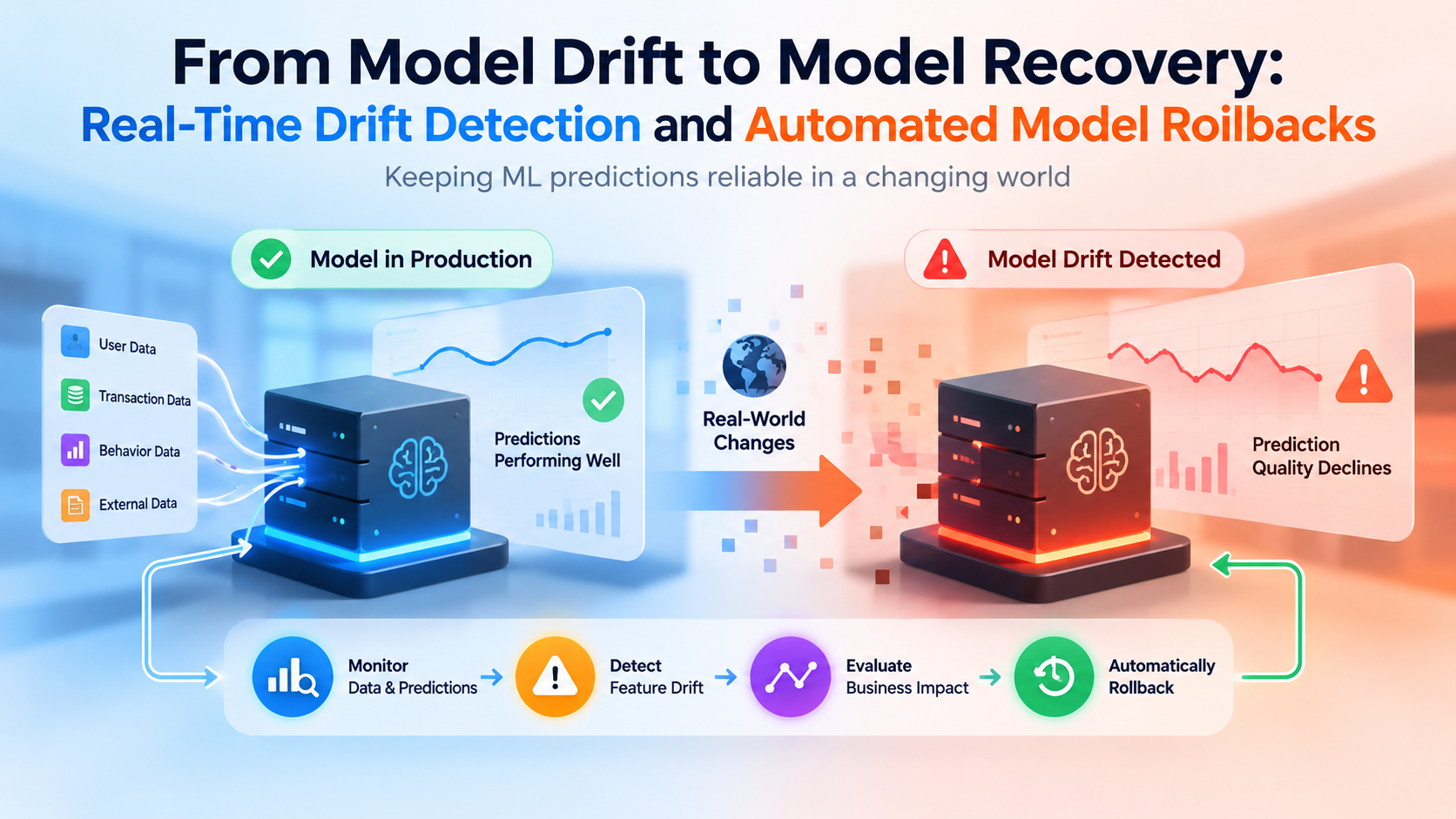
A production model should not only make predictions; it should continuously demonstrate that its predictions are still trustworthy. Models learn from historical data, while customers, markets, devices, and operating conditions keep changing. An endpoint can remain healthy and return valid responses even as the assumptions behind its predictions become less representative.
Drift monitoring provides an early warning, not a verdict. A reliable operating pattern combines data and model signals with business impact, investigates the cause, and restores a validated known-good version when risk warrants it. Retraining follows only when new data and validation show that a replacement is ready.
Why Models Decay?
Traditional service monitoring catches visible failures such as crashes, unavailable databases, elevated latency, or infrastructure faults. Machine learning adds a quieter failure mode: the service remains healthy while production inputs move away from the model’s learned assumptions. Predictions are well-formed, but less useful. This is silent degradation.

A fraud model may continue scoring transactions while missing patterns from a newly popular payment channel. Google’s production ML research treats data and model validation as continuous pipeline concerns. NIST’s recent work likewise highlights post-deployment monitoring to observe real-world behavior and guide mitigation.
What is a Drift and How they vary?
Drift is a change in the data, relationships, or model outputs observed in production compared with expected or reference behavior. It helps teams ask better questions; it is not synonymous with model failure. Four forms are useful to distinguish.
Data drift: inputs have changed
Data or feature drift occurs when the distribution of model inputs changes. Suppose training traffic was 55% mobile and 45% desktop, while current traffic is 82% mobile and 18% desktop. The model now operates in a different mix of contexts. That may matter, or it may reflect a planned shift to mobile.
Device | Training baseline | Production window |
|---|---|---|
Mobile | 55% | 82% |
Desktop | 45% | 18% |
Tools such as Evidently can compare reference and current distributions. The comparison points to where to investigate; it does not show that outcomes worsened.
Concept drift: the relationship has changed
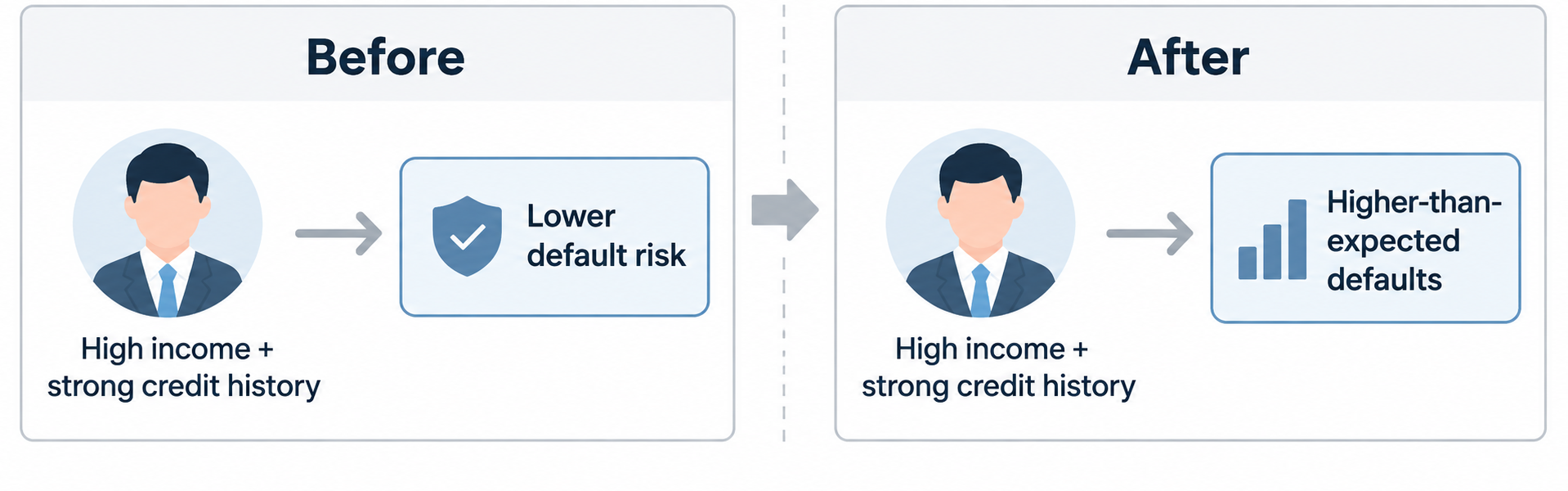
Concept drift occurs when the relationship between inputs and outcomes changes. A credit model may learn that high income and strong credit history predict lower default risk. Changed economic conditions can weaken that relationship while feature distributions still look familiar. Confirming concept drift usually requires outcome labels, which may arrive later.
Data drift means the inputs changed. Concept drift means the relationship between inputs and outcomes changed.
Prediction drift: outputs have changed
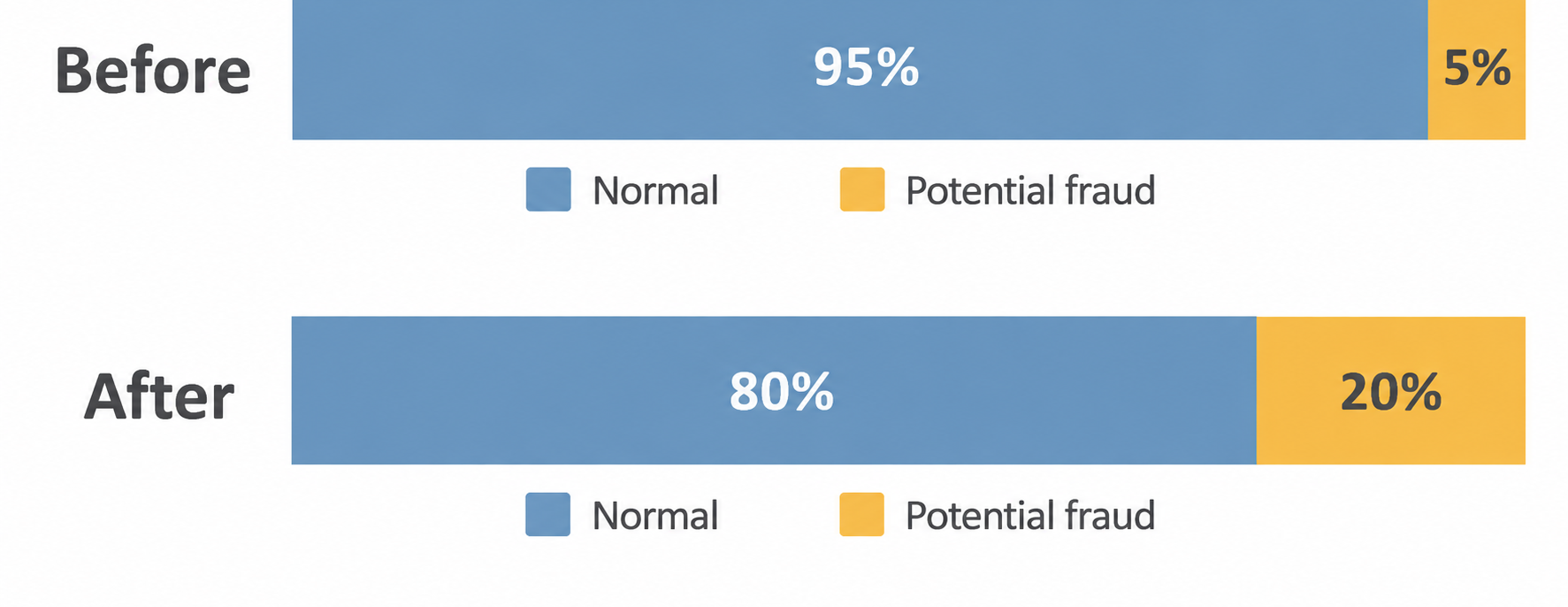
Prediction drift is a change in the distribution of model outputs. A fraud classifier might move from 95% “normal” and 5% “potential fraud” predictions to 80% and 20%. This is useful when labels are delayed, but may also reflect more fraud or an upstream issue. It is not proof of model failure.
Prediction class | Before | After |
|---|---|---|
Normal | 95% | 80% |
Potential fraud | 5% | 20% |
Data-quality drift: the pipeline may be broken
Nulls, duplicates, new categories, schema changes, invalid ranges, missing columns, stale records, delayed events, or a broken pipeline can look like drift. Ask: “Is the environment changing, or is the data arriving incorrectly?” Great Expectations (GX) supports defining and checking data expectations.
Do not automatically roll back a model when the actual problem is corrupted or incomplete input data.
Detect Early, Then Evaluate Risk
A practical monitoring system compares production windows with a suitable baseline and checks input features, predictions, data quality, service health, and—when labels arrive—outcome quality. The baseline should represent a validated period or dataset, with seasonality and known operating changes documented. Version and review baselines as the business evolves; one reference is not permanent truth.
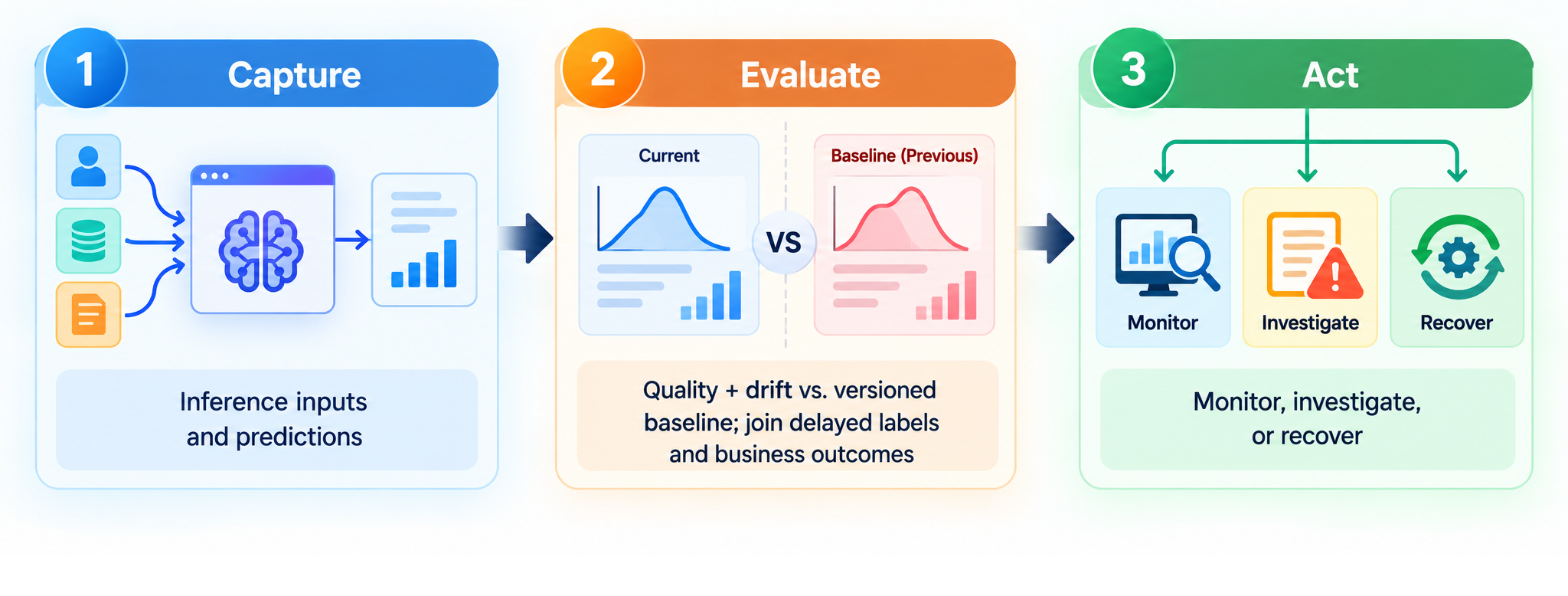
Match detection frequency to risk and data availability. Streaming systems may need near-real-time schema and feature checks; outcome quality may be measurable only after labels mature. Latency and time to first token (TTFT) describe service responsiveness, not statistical drift.
Set Thresholds Around Context
Thresholds are contextual: a modest shift in a critical feature may matter, while a larger seasonal shift may be expected. Set thresholds using historical variation, feature importance, label delays, decision costs, and business context. Use review windows and persistence rules to filter one-off noise. No universal drift percentage means “roll back.”
Persistent drift | Quality or KPI worsens | Input data valid | Decision |
|---|---|---|---|
Yes | Yes, material risk | Yes | Rollback and verify |
Any other combination | Investigate cause | Check pipeline | Monitor or repair |
Decide Whether the Change Matters
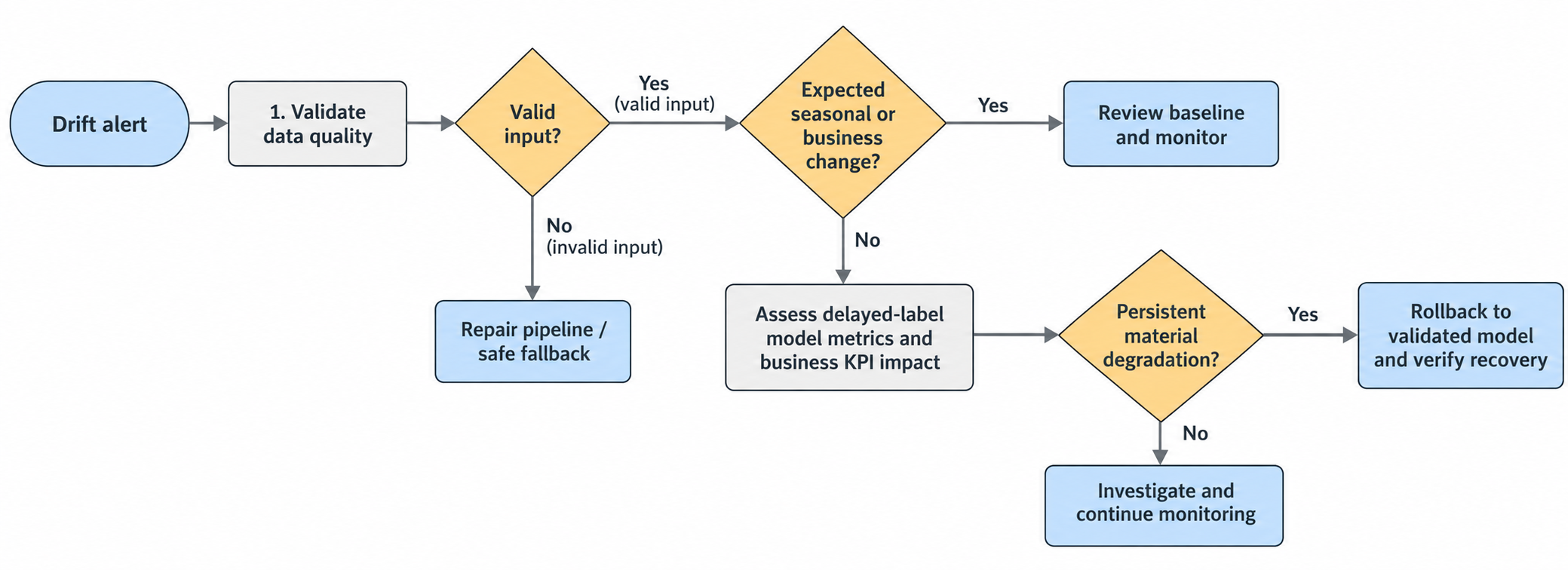
Combine signals rather than treating one statistical alert as an incident. Check input quality and schema, persistence across windows, prediction changes, delayed-label metrics such as precision, recall, calibration, or error, and business indicators such as fraud loss or approval quality. Look for legitimate causes like a new region, product, policy, or seasonal event.
Route data-quality failures to pipeline repair or a safe fallback. Expected changes may call for a reviewed baseline or controlled update. Persistent, material degradation is a rollback candidate. High-impact decisions may still need human approval.
Finding | Response |
|---|---|
Invalid or incomplete data | Repair pipeline; use safe fallback if needed |
Expected seasonal or business change | Review baseline and monitor |
Persistent degradation with material impact | Rollback to validated model; verify recovery |
Roll Back Safely and Verify Recovery
Automated rollback is a deployment control, not a remedy for every anomaly. Keep a validated known-good model and its artifact, configuration, schema, dependencies, and lineage. Record model and data versions for predictions. MLflow can organize model versions and aliases; the serving system also needs a tested traffic switch.
Canary or champion–challenger deployment exposes a candidate to limited traffic while the current version remains available. On a rollback trigger, restore traffic to the approved model, verify service health and business recovery, alert owners, and record the evidence and versions. Google Cloud’s canary guidance describes this progressive rollout and verification pattern.
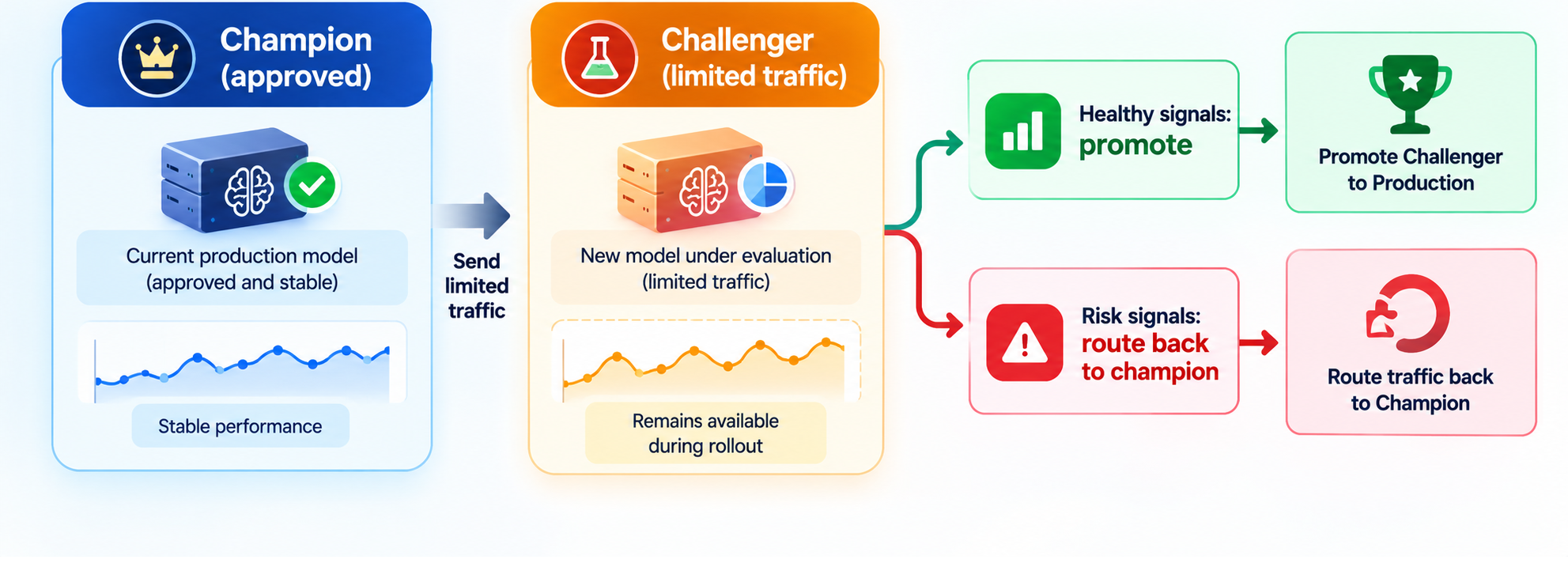
Rollback restores known-good behavior; it does not explain the cause. After stabilization, determine whether the issue came from data quality, environmental change, model limitations, or an unintended release. Retrain only when representative data is available and the candidate passes offline evaluation, safety checks, and deployment validation. Automatic retraining without validation can replace one degraded model with another.
Enterprise Operating Principles
Monitor data, predictions, outcomes, and service health together.
Treat drift as evidence to evaluate, not an automatic rollback command.
Set thresholds around business risk, baseline variation, and seasonality.
Keep a known-good model and traceable model, data, and deployment versions.
Verify recovery after rollback and validate every retrained candidate.
Use canaries where appropriate, with human approval for high-risk decisions.
Conclusion
Drift is normal in production AI. The risk comes when it becomes invisible, persistent, unmeasured, or unmanaged. Mature systems observe, detect, evaluate, recover, and learn.
At YTT Global, we help enterprises design production-ready AI/ML architectures where monitoring, drift detection, governance, and recovery are built into the operating model. Talk with YTT Global about making your production AI/ML systems more reliable.
Production AI should not simply remain available. It should continuously prove that it remains reliable.
References
Rao, A., et al. (2026). Challenges to the monitoring of deployed AI systems. NIST AI 800-4.
Caveness, E., et al. (2020). TensorFlow Data Validation: Data Analysis and Validation in Continuous ML Pipelines. Google Research.
Rosen, E., et al. (2021). Validating Data and Models in Continuous ML Pipelines. Google Research.
Evidently AI. (n.d.). Data drift documentation.
Great Expectations. (n.d.). Expectations documentation.
Google Cloud. (2024). Vertex AI Model Monitoring capabilities.
MLflow. (n.d.). Model Registry Workflows.
Google Cloud. (n.d.). Use a canary deployment strategy.
Want us to build this for your team?
We design and ship enterprise AI systems — from architecture to production. Book a 30-minute call and we'll map out exactly how it fits your stack.
About the Author
Related Articles
Why We Built an AI That Refuses to Act Without You
A walkthrough of the Zero-Drift framework: Three autonomous agents, One human gate, and why that's the only way enterprise AI can actually ship.
Security Architecture for Multi AI Agent Networks
Designing Trust, Control, and Resilience for Interacting AI Systems
Cost–Latency Optimization for LLM Serving Engines Batching and Quantization
Optimizing LLMs for speed, cost, and scalability.