2026 Is the Year Enterprises Stop Trusting a Single Cloud: A Multi-Cloud Resilience Playbook
AWS, Azure, and Google Cloud all suffered major outages within the same year. Here's what happened, and how to architect real resilience without the cost spiraling.
Summary
Three hyperscalers, three outages, one uncomfortable truth: AWS, Microsoft Azure, and Google Cloud each went down hard within the same year, and each failure traced back to the same root problem — a handful of shared, invisible dependencies sitting underneath services that were supposed to be independent. This piece walks through what actually happened in each incident, what the data says about how enterprises are responding, and where multi-cloud resilience genuinely earns its cost versus where it's just an expensive way to feel safer. It includes a full reference architecture — AWS as the active primary, Azure as a warm standby recovery environment — covering traffic failover, data replication, identity, observability, and infrastructure as code, plus the six-step sequence of what actually happens during a real failover and the failback that follows it. It closes with the honest costs nobody puts in the pitch deck, the questions worth asking before signing off on a build, and how YTT Global scopes this kind of work for clients so it solves a real business risk instead of becoming a permanent, expensive science project.
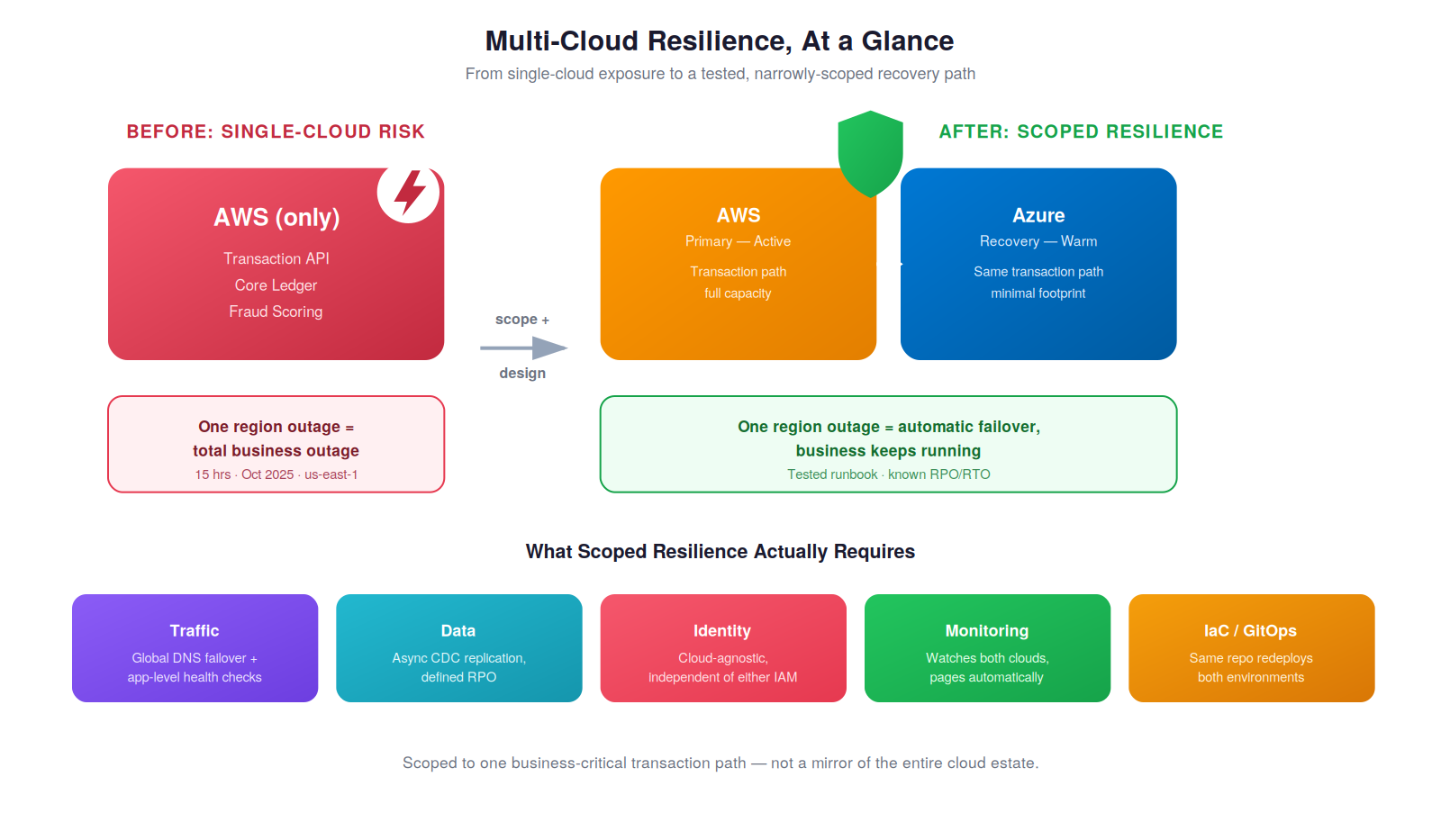
A single race condition in AWS's DNS automation for DynamoDB triggered fifteen hours of disruption that reached far beyond Amazon's own infrastructure. Snapchat went dark for hundreds of millions of users, Fortnite and Roblox became unplayable, Ring doorbells stopped recording, McDonald's couldn't process mobile orders, United Airlines' booking systems stuttered, and the UK's tax authority website went offline — all traced back to the same failure inside a single AWS region. It's a striking illustration of a fact most technology leaders have known for years but rarely had to reckon with directly: the infrastructure modern business runs on is far more interconnected, and far more fragile at the edges of that interconnection, than most architecture diagrams suggest.
If you run infrastructure for a living, you already know this story, or one very much like it. What's changed is how many boardrooms now know it too. A cloud outage used to be an engineering incident explained in a postmortem that nobody outside the platform team ever read. It's now a topic CFOs raise directly in strategy meetings, because the last eighteen months gave them a great deal of material to work with.
The Pattern Behind Recent Cloud Outages
Here's an uncomfortable fact about modern cloud infrastructure: the hyperscalers have grown so large and so internally interconnected that a single misbehaving component can take down services that have nothing obvious to do with each other. AWS's US-EAST-1 region is the clearest example. It isn't just a region — it's a load-bearing wall for large parts of AWS's global control plane. Identity and access authentication, the CDN edge network, DNS resolution, and cross-region database replication all lean on US-EAST-1 endpoints, even when a company's actual workloads run in Frankfurt or Singapore. AWS is the only major hyperscaler that documents these cross-region dependencies publicly, in its own fault-isolation architecture guidance, which says something about how seriously the industry takes this problem versus how openly it's willing to discuss it.
AWS wasn't alone during this period. Roughly a week after the DynamoDB incident, Microsoft had its own difficult day. An unintended configuration change pushed to Azure Front Door — the CDN and edge-routing layer sitting in front of a large share of Microsoft's own services and thousands of customer applications — propagated faulty routing data across the fleet. Microsoft 365, Outlook, Xbox Live, and Copilot all degraded, and so did customer-facing systems at Costco, Starbucks, and Alaska Airlines. The detail that stung: the Azure Portal itself, the tool engineers needed to diagnose the problem, was also sitting behind Front Door, so Microsoft's own responders had to reroute the portal away from the broken service before they could begin fixing the broken service.
Google had its turn a few months earlier. A policy update replicated through Spanner, Google's globally distributed database, carried blank fields that a newly enabled quota-checking process wasn't built to handle. The result was a crash in Service Control, the component that authorizes nearly every API call across Google Cloud. Because policy data replicates globally and almost instantly by design, the corrupted state spread to every region within seconds. Gmail, Drive, Spotify, Discord, Snapchat, and services dependent on Cloudflare all felt it, and recovery in one core region took longer than everywhere else because thousands of Service Control instances restarted simultaneously and overwhelmed the database a second time — a self-inflicted failure layered on top of the original one.
None of these three incidents were caused by hardware failing in some dramatic way. They were caused by automation, configuration, and the sheer density of dependencies inside systems that have grown almost too large to fully reason about, even for the people who built them. That's the real lesson of this period, and it's a more unsettling one than "outages happen." The failure modes of hyperscale clouds are increasingly systemic rather than local, and systemic failures don't respect a carefully designed multi-availability-zone architecture if everything still sits inside one provider's control plane.
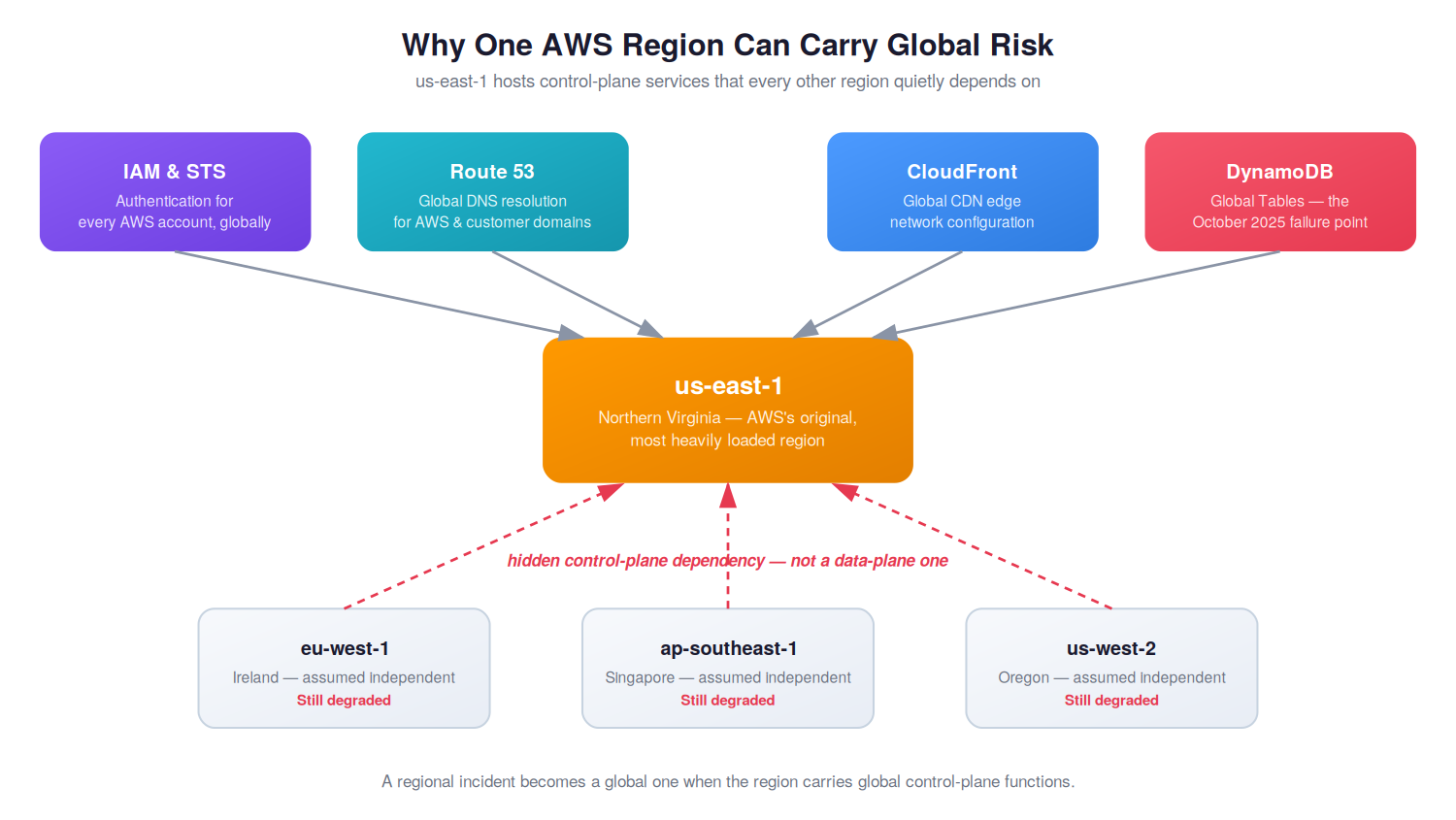
This dependency structure is the part of the story that doesn't get enough attention. Most engineering teams assume that if their workloads run in, say, a European region, an incident on the other side of the Atlantic is somebody else's problem. It usually isn't. Because so much of a hyperscaler's global control plane — authentication, DNS, the edge network, cross-region replication — physically lives in one or two anchor regions, a bad day there can quietly degrade regions that never went down themselves. Teams running entirely outside the affected region still saw authentication failures and stale DNS during the AWS incident, because what broke wasn't a region — it was a piece of shared plumbing that every region depends on.
What the Data Shows About Enterprise Cloud Strategy
This isn't just a shift in mood among engineers who lived through a bad on-call week. It shows up clearly in enterprise adoption data. Recent research on the state of enterprise cloud puts hybrid cloud usage above seven in ten organizations, with a further meaningful share running multi-cloud without any private infrastructure component — meaning something close to nine in ten enterprises are now deliberately spreading workloads across more than one environment rather than betting everything on a single provider. When asked why, the top reason enterprises give is avoiding vendor lock-in, followed by better price-performance matching per workload, and then data locality or compliance requirements. Resilience against outages is a real factor in that decision, but it isn't even the leading one — it sits alongside commercial and technical motivations that would exist in a world where clouds never went down at all.
Industry research on downtime tolerance explains why boards are paying closer attention. A large-scale survey of senior IT and executive leaders found that more than eight in ten organizations had experienced an outage in the past five years that wasn't resolved quickly, and a majority said their business couldn't realistically absorb three straight days of downtime. Separate research on cloud concentration risk found that the overwhelming majority of surveyed organizations would face severe or critical disruption from a full week-long outage at a single cloud vendor. Whether a given organization sits in that majority is worth an honest internal conversation, because most leadership teams have never actually modeled the scenario in concrete terms.
There's a less flattering data point too, and it matters for anyone treating multi-cloud as a free resilience upgrade. Research into hybrid and multi-cloud security policy management found that roughly two-thirds of organizations had experienced at least one business-critical application outage in the past year caused by a misconfigured security policy, with close to half experiencing two or more such incidents, and only a small fraction reporting that security policy management was genuinely integrated into their deployment workflows. Spreading workloads across providers multiplies the number of places a misconfiguration can happen, unless matched by real investment in the operational discipline needed to manage that complexity. More clouds without more governance isn't resilience — it's simply more surface area.
Defining Multi-Cloud Resilience Precisely
It's worth being precise here, because "multi-cloud" gets used to describe at least three very different situations, and treating them as one is where a lot of expensive mistakes start.
The first is multi-cloud by accident — different business units picked different providers over the years, nobody planned it, and the result is sprawl with no coordinated resilience story. The second is multi-cloud for best-of-breed reasons — running analytics on one provider because the data tooling is genuinely better there, while transactional systems live somewhere else. That's a legitimate architectural decision, but it's workload placement, not resilience engineering. The third is what this playbook is actually about: deliberately architecting a business-critical application so that it can keep functioning, in some meaningful form, when the cloud environment it normally depends on becomes unavailable.
Only that third definition earns the word "resilience." And it comes with a corollary that vendors selling multi-cloud tooling rarely say out loud: most workloads don't need it. Running everything active-active across three clouds looks impressive in a slide deck and is usually the wrong answer. The right question isn't "should we be multi-cloud." It's "which of our workloads would genuinely hurt the business if they were down for six, twelve, or twenty-four hours, and what's the most cost-effective way to make sure that specific set of systems survives a single provider going dark."
When Multi-Cloud Resilience Is Justified — and When It Isn't
Multi-cloud resilience earns its cost for a narrow but important category of workloads: payment processing and settlement systems, core trading or exchange infrastructure, identity and authentication services that gate access to everything else, systems carrying regulatory continuity requirements (parts of financial services and healthcare fall here explicitly), and anything where an hour of downtime translates directly into a headline or a fine.
It's usually not worth it for internal tooling, most analytics and batch workloads, development and test environments, and applications where a few hours of degraded service is an inconvenience rather than a genuine business event. For those workloads, money is far better spent on solid single-cloud practices — multi-region deployment, well-tested backups, properly implemented infrastructure as code, and realistic disaster recovery drills — than on standing up a second cloud's worth of infrastructure that will rarely be used and will constantly need to be kept in sync.
The workload-repatriation trend backs this up in an interesting way. Recent European cloud research found a meaningful share of companies moving workloads back on-premises, driven primarily by cost concerns and compliance requirements. That's not an anti-cloud signal so much as evidence that organizations are becoming more deliberate about workload placement generally — putting systems where they actually belong instead of defaulting everything to whatever platform was fashionable several years earlier. Multi-cloud resilience deserves the same discipline: a deliberate placement decision for a defined set of workloads, not a blanket policy applied everywhere.
A Reference Architecture: AWS Primary, Azure Recovery
Consider a mid-size payments company whose core transaction platform has run on AWS for years — the team knows it well, and most of the workload has no reason to move. But the risk committee has started asking what happens if AWS has another region-scale event, and this time it lands during peak processing.
Here's roughly how that gets solved in practice, without mirroring the entire AWS footprint somewhere else.
Primary and recovery placement. The transaction API, the core ledger service, and the fraud-scoring pipeline run in AWS across multiple availability zones, as they always have. A parallel, minimally scaled version of the same services runs in Azure, in a different geographic region from the AWS primary, kept warm but running at a fraction of production capacity — enough to take real traffic within minutes, without the cost of full duplicate infrastructure running year-round.
Traffic redirection. A DNS-based global traffic manager, provider-agnostic rather than tied to either cloud's native routing service, sits in front of both environments. Health checks continuously probe real application-level health — confirming that the ledger service can complete an end-to-end test transaction, not just that a server responds to a ping. If AWS health checks fail past a defined threshold, traffic shifts to Azure automatically, tuned to avoid unnecessary failover triggered by transient blips.
Data protection. The ledger database replicates asynchronously from AWS to Azure using change-data-capture, against a defined and tested recovery point objective. The organization decides upfront how much transaction data it can afford to lose in a worst-case failover, because near-zero data loss across providers at real scale carries meaningful cost and latency on every write. Object storage for transaction records and audit logs replicates on a schedule with integrity verification, not an unverified copy job nobody checks.
Identity. This is the piece people most often underestimate. An identity provider can't live only inside the cloud that might fail — if AWS IAM authenticates access to the recovery environment and AWS is down, the recovery plan can't be activated. A cloud-agnostic identity layer handles authentication for both environments, with service-to-service authentication relying on credentials that don't depend on either cloud's native identity service being reachable.
Monitoring and detection. Observability tooling that isn't itself hosted exclusively inside the cloud being watched monitors both environments, correlates native service-health dashboards with the organization's own application-level metrics, and pages the on-call team the moment synthetic transactions start failing, rather than waiting for a person to notice.
Infrastructure recreation. Both environments are defined in the same Infrastructure-as-Code repository, using provider-agnostic tooling with cloud-specific modules, so the Azure environment isn't a manually built system nobody trusts during a real incident. Where Kubernetes is in use, it runs on both sides with the same manifests, supported by a GitOps pipeline that can redeploy the full application stack in Azure within minutes if scaled beyond its warm-standby baseline.
During an actual regional or provider-level outage: health checks fail, traffic shifts to Azure, the ledger continues processing transactions against replicated data with a known, communicated recovery point, and the team manages the incident using tooling and identity that don't depend on AWS being reachable. Once AWS recovers, the company doesn't immediately flip back — it reconciles transactions that occurred in Azure during the failover window, verifies data consistency between environments, and executes a controlled failback during a scheduled low-traffic period.
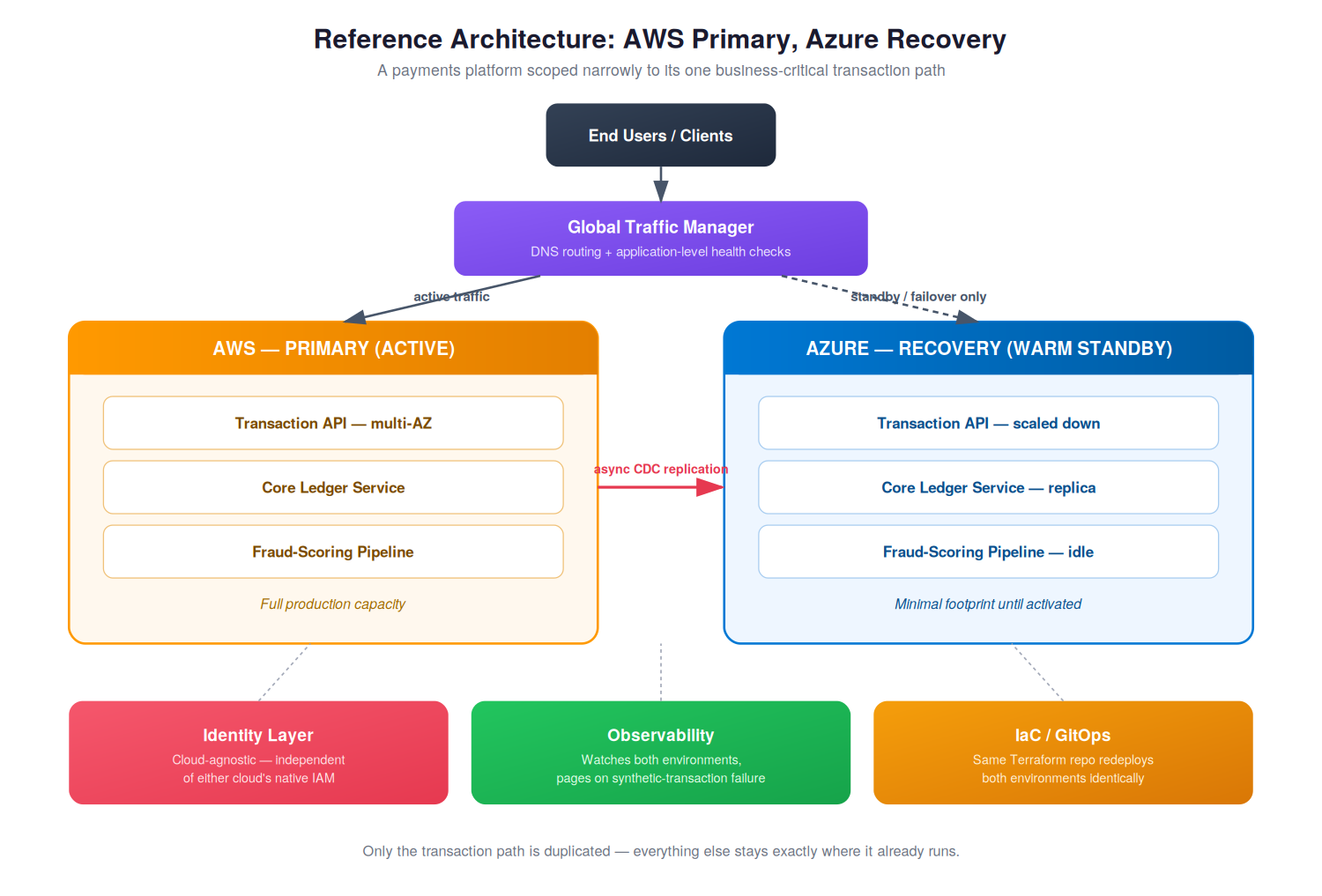
Notice what's deliberately absent from this picture: the fraud-scoring pipeline's model training jobs, internal reporting dashboards, the marketing site, the HR system. None of that gets a second copy in Azure. Duplication is scoped tightly to the transaction path — the one component that would actually hurt the business if it stopped working for a day. That scoping is what keeps the approach affordable; trying to mirror an entire cloud account into a second provider is how multi-cloud initiatives quietly become the most expensive thing an IT organization has ever built.
Here's how that architecture behaves during a real incident, step by step:
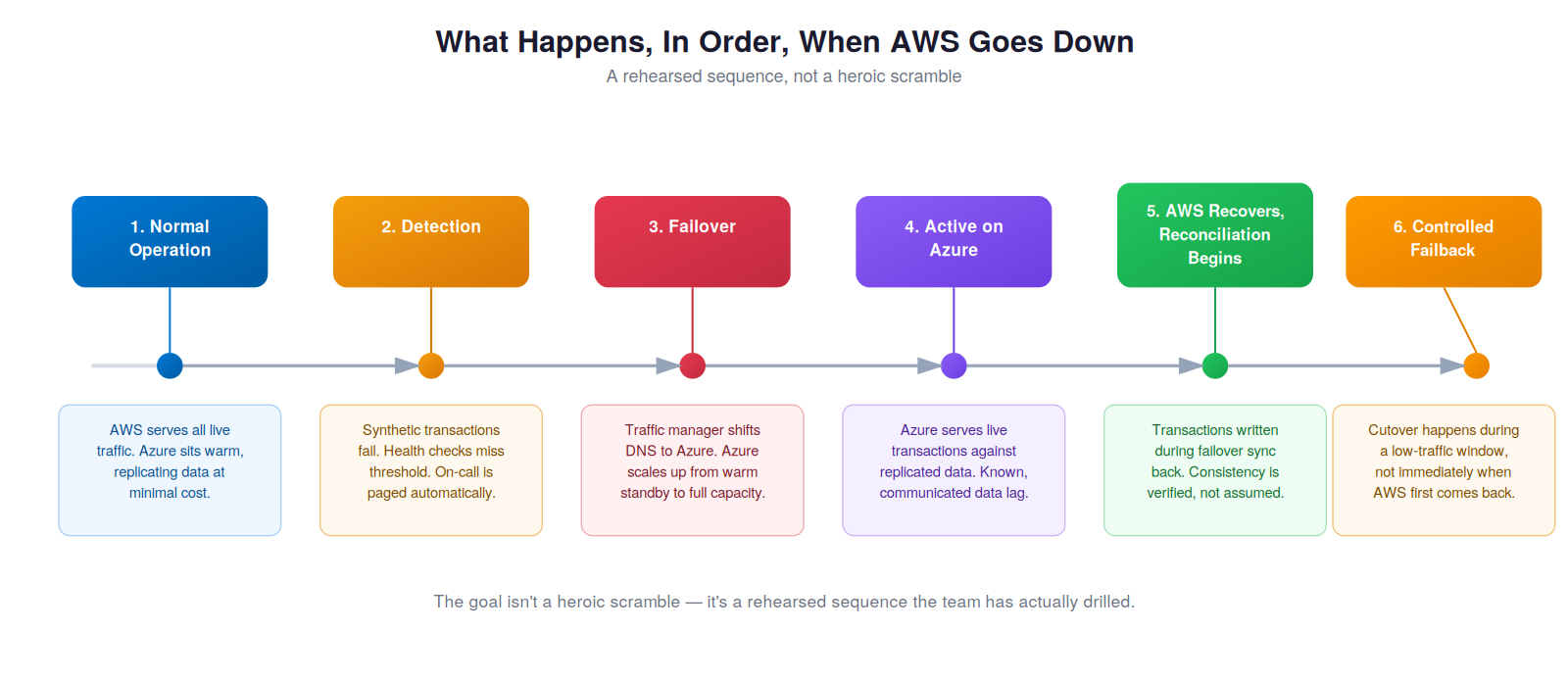
The detail worth sitting with is the final step. Many failover plans are designed and tested only up to the point traffic successfully lands on the recovery cloud, with little thought given to the return journey. Failback is arguably the riskier moment — live traffic and data get reconciled a second time, typically under less urgency and more temptation to move quickly because the crisis "already happened." Executing it during a scheduled, low-traffic window with a verified data-consistency check is what separates a mature resilience program from an improvised one.
This kind of architecture is genuinely expensive. It requires a second cloud relationship, duplicated infrastructure even at minimal scale, cross-cloud networking, and staff who understand two providers well enough to operate this during a 3 a.m. incident, not just build it during a calm sprint. It isn't something to build for an internal expense-reporting tool.
The Costs Frequently Left Out of the Business Case
The hidden costs of multi-cloud resilience deserve honest treatment. Data egress between cloud providers is billed by both sides and adds up quickly at meaningful replication volumes. Cross-cloud networking — over the public internet, VPN, or dedicated interconnects — adds latency and another layer of things that can break. Observability becomes genuinely harder, since signals from two platforms with different native tooling have to be correlated, which is exactly why more teams are standardizing on provider-agnostic monitoring rather than stitching together disparate platform-native tools after the fact. Staffing is often the quietest cost of all: engineers who are excellent in AWS need to become competent in Azure too, usually without a matching increase in team capacity. Kubernetes adoption has made workload portability considerably easier — enterprise adoption has roughly doubled over the past two years — but it doesn't eliminate the real differences in managed database services, IAM models, and networking primitives between providers, which is where most of the integration effort still lives.
Questions to Ask Before Committing to Multi-Cloud Resilience
Before signing off on a multi-cloud resilience program, a handful of questions tend to separate organizations that get real value from ones that end up with a large bill and a more fragile system than they started with. Which specific workloads would cause measurable business harm if down for a defined period, and has that harm actually been quantified rather than assumed? What's the realistic recovery point and recovery time objective for each of those workloads, expressed in terms finance would recognize? Is there genuine operational maturity — tested runbooks and executed failover drills, not tabletop exercises alone — to run a cross-cloud failover under real incident pressure? And has the ongoing operational cost been priced honestly, recognizing that the recovery environment needs to be maintained, patched, and drilled indefinitely, not stood up once and left alone?
How YTT Global Approaches Multi-Cloud Resilience
Most organizations don't need a diagram like the one above for every system they run — they need a disciplined way to figure out which handful of systems actually deserve one, and then the engineering depth to build it properly. That's the core of how YTT Global approaches this work with clients.
The starting point is always a workload risk assessment rather than a technology conversation. Before any discussion of a second cloud, the priority is understanding which applications genuinely carry business-critical downtime risk, what recovery time and recovery point objectives are realistic for each, and what the actual cost of an outage would be in dollars, not just in engineering embarrassment. That assessment routinely rules out multi-cloud resilience for the majority of an organization's workloads — which is usually the right outcome, and often the most valuable part of the engagement.
For the systems that do qualify, the approach favors narrow, well-tested scope over broad, aspirational coverage. That means designing the specific reference architecture a workload needs — traffic management, data replication, identity, observability, and infrastructure as code — rather than a generic multi-cloud platform meant to cover everything eventually. Kubernetes and Terraform-based infrastructure as code are used deliberately so that a recovery environment isn't a manually assembled system nobody trusts when it matters; if it can't be redeployed automatically from the same repository as the primary environment, it isn't considered production-ready.
Equally important is what happens after the architecture is built. A failover path that has never actually been exercised under realistic conditions is a diagram, not a capability. Part of the engagement model includes structured failover testing and drills, not just documentation, because the value of this kind of resilience work is proven during an actual incident, not during a design review.
Having supported cloud and infrastructure engagements across sectors including energy, aviation, government, and technology — with organizations such as Duke Energy, United Airlines, Cisco, Qualcomm, CMS, USPTO, and the Georgia Technology Authority — YTT Global brings direct familiarity with the operational realities of running critical systems at enterprise scale: the coordination between security, compliance, and engineering teams, the pace of real incident response, and the discipline required to keep a resilience plan credible long after it's first built. That experience shapes an approach that treats multi-cloud resilience as an engineering discipline scoped to genuine business risk, not a platform initiative pursued for its own sake.
Where Cloud Resilience Strategy Is Headed
The major cloud providers aren't going to stop having incidents. They operate at a scale and complexity where perfect reliability isn't achievable, and the nature of their recent failures — control-plane cascades, configuration propagation, automation racing against itself — may be getting harder to fully prevent as these platforms keep growing, not easier. What's changing in 2026 isn't cloud reliability. It's enterprise honesty about what single-provider dependency actually costs when things go wrong, paired with a more disciplined willingness to invest real engineering effort in the specific systems where that cost is unacceptable, rather than either ignoring the risk entirely or chasing full multi-cloud parity out of anxiety.
The architects who get this right over the next few years won't be the ones running identical infrastructure across two or three clouds. They'll be the ones who can say, with real confidence backed by a tested runbook, exactly which of their systems can survive their primary cloud going dark for a day — having made a deliberate, informed decision that everything else doesn't need to.
References
Network World — "AWS hit by US-East-1 outage after data center thermal event"
https://www.networkworld.com/article/4168878/aws-hit-by-us-east-1-outage-after-data-center-thermal-event.htmlThousandEyes — "Microsoft Azure Front Door Outage Analysis: October 29, 2025"
https://www.thousandeyes.com/blog/microsoft-azure-front-door-outage-analysis-october-29-2025TechCrunch — "Google Cloud outage brings down a lot of the internet"
https://techcrunch.com/2025/06/12/google-cloud-outage-brings-down-a-lot-of-the-internet/Searchlab — "Cloud Computing Statistics 2026" (compiling Flexera, CNCF, and IDC data)
https://searchlab.nl/en/statistics/cloud-computing-statistics-2026Shattered.io — "AWS Outage Hits 28 Hours, Third us-east-1 Failure [2026]" (citing Cloud Security Alliance concentration-risk research)
https://shattered.io/aws-outage-28-hours-us-east-1-2026/
Want us to build this for your team?
We design and ship enterprise AI systems — from architecture to production. Book a 30-minute call and we'll map out exactly how it fits your stack.
About the Author
Srinidhi K
Related Articles
Why We Built an AI That Refuses to Act Without You
A walkthrough of the Zero-Drift framework: Three autonomous agents, One human gate, and why that's the only way enterprise AI can actually ship.
Tokenomics: Why Enterprise AI Budgets Broke in 2026, and the Discipline That Fixes It
How "tokenmaxxing" quietly became the biggest budget risk in enterprise technology, and what CFOs and CTOs need to do about it now.
Security Architecture for Multi AI Agent Networks
Designing Trust, Control, and Resilience for Interacting AI Systems